
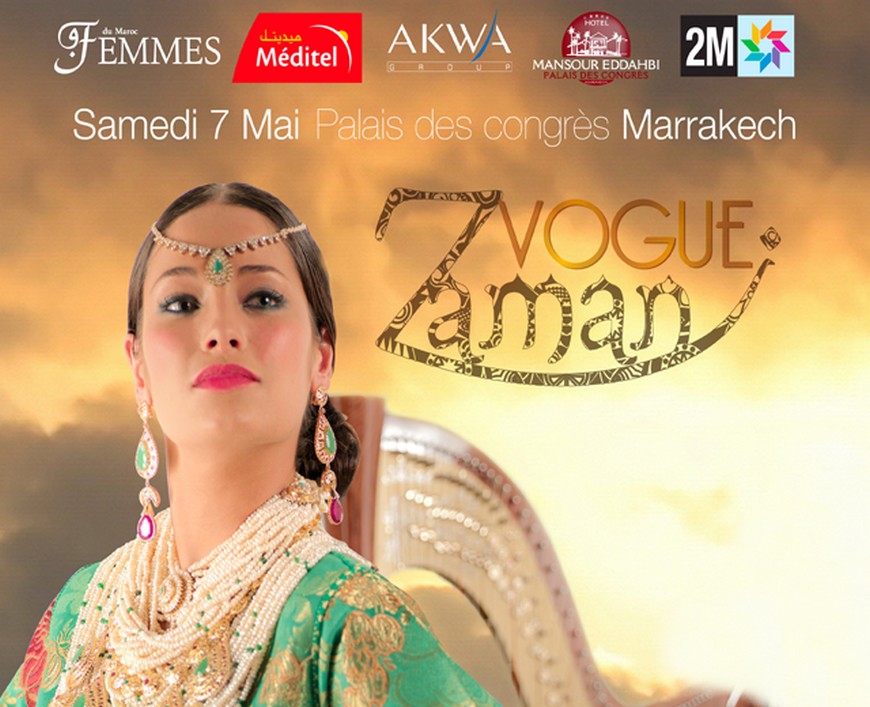
Already fifteen years since Kaftan has been making millions of viewers dream through its prime-time broadcast on national and international channels, revealing talents, and celebrating Moroccan creativity and genius...
Fifteen years of designers marvelling at the beauty and glamour of their creations.
Fifteen years since the cause of rural schoolgirls was first highlighted...
It has already been fifteen years since the Kaftan evening has been the absolute must-attend event for Moroccan and foreign businesswomen and businessmen to network!
For its fifteenth anniversary, the event returns to the roots of Kaftan Moroccanto the origins of our designers' inspiration, to the story of our history...
Vogue Zaman draws on the past to embrace the future!
Orchestra conductor Kaftan 2011
A Moroccan who grew up in the Netherlands, Said Mahrouf is now one of the most established artists of his generation.
A graduate of the Grrit Rietvield Academy in Amsterdam and trained at the Pratt Institute in New York, Said Mahrouf embodies with panache the new guard of designers of which Morocco can be proud.
Said Mahrouf's personality, his relationship with space, his geometric precision, and his undeniable talent for projecting the codes of kaftan into the future will be essential keys in establishing the identity of this new artistic direction.
Following an unforgettable 2010 edition, the 15th edition of KAFTAN is already shaping up to be one of the most anticipated events of the year.
Said Mahrouf also brings to the event the relevance of his creative vision and his contemporary interpretation of the female silhouette.
Datasheet Kaftan 2011
A birthday party reveals its theme: 15 years
An appointment: May 7, 2011, Salle Royale du Palais des Congrès de Marrakech
A cause: Organized to promote schooling for girls in rural areas ( CSSF)
10 haute couture designers : 8 outfits by stylists (in reference to the "Vogue Zaman" theme)
Glamour, people : VIP evening after the show
The must-have of the year: Officials, Moroccan and international artistsx
Kaftan 2011 A birthday unveils its theme!
Materials :
The zaman spirit calls for noble fabrics, rigid textures and weaves enriched with gold and silver thread. Changing reflections are the order of the day.
In keeping with the Vogue Zaman theme, we'll be opting for textiles such as brocade, velvet, organza, tlijja, two-tone johara, devoured velvet...
Fluid, transparent materials can't be ruled out, and silk chiffon, pleated crepe and silk satin can be mixed with other heavier materials to bring a modern spirit and a touch of sensuality, voluptuousness and lightness to the combinations of materials, which can be created according to the imagination of the stylists.
When it comes to colors, certain codes are to be favored. Green and burgundy red, the flagship shades of the makhzani style, are to take center stage.
As for brocades, color or silver shades, with hints of yellow, orange, magenta, primary green, soft blue...are the preferred choice.
It's okay to create color harmonies to suit any trend, whether international or local.
For materials, influences can come from fashion capitals and the catwalks of international haute couture.
Fur, lace, leather and suede can also be included in the looks created, while maintaining a mastery of blends and a balance of textures.
Anything goes, as long as it respects the above-mentioned guidelines and succeeds in the challenge of daring yet controlled mixes. The choice and mix of materials should reflect the paradoxical nature of the Vogue Zaman theme.
Plains can be embellished with transfers, embroidery, various prints, crystal pavings, rhinestones, tassels...
Lines:
The guiding principle is zaman: straight cut with side khrates (a kind of yoke that starts at the armhole and extends to the bottom hem), oversized square sleeves, rounded neckline.
Wider versions at the bottom are among the possibilities, and this rigid, somewhat austere base will be enhanced by the influence of more modern lines.
Modern lines include flared, draped, side keels, empire waist, bouillonné style, balloon sleeves...
To this non-exhaustive list can also be added details such as swan collars, mao collars, gathers, box pleats, flat pleats...
Once again, it is the combination of both genres that matches the style guide of this edition of Kaftan.
The goal is to find the right balance—one that draws on the lines of the past and takes inspiration from contemporary forms—to create the trend that will set the standard for traditional fashion, not only for fabric manufacturers, weavers, and designers across all specialties—but also to offer caftans-loving customers a sense of excitement, creativity, a healthy dose of whimsy, and boldness…
Finishes :
Sfiffa in all its splendor, with a special focus on sfiffa dial mrama, an important part of the Moroccan craft tradition.
The sfiffa in gold- or silver-colored skalli sam, because skalli sam, originally dipped in pure gold, remains a sure bet in traditional sewing and is a major ingredient in the Zaman tradition.
To be more in keeping with the vogue, it makes sense to introduce colored lurex thread in harmony with the chosen textures. It's an opportunity to bring light to creations and give them a more contemporary cachet.
Akkads kermossa, with or without pattern (najma), in two-tone versions, in silk thread, in pure skalli, are a must-have in the Vogue Zaman collections.
The kitane, which forms sturdy eyelets to enclose the akkads, is also a guarantee of authenticity, far ahead of the basic cord that is so common today.
The toualah, the side cut-outs enhanced with rigid sfiffa, are also a major detail that invites you to travel, a journey through time for
lift it up, tame it, domesticate it and pay tribute to those who made the kaftan, the first caftans, those who helped slide this
from men's to women's wardrobes.
Equally important are the khrates, a cut detail that certifies the "zaman spirit". For assembly, yokes can be marked and lines emphasized.
As for the front bib, the zwaak is an almost indispensable stamp, made of transsen maalem (gold skalli thread) to draw essentially arabesque shapes, flowers...
The resulting drawings have a naive style.
Colors :
It's important to choose three or four dominant colors, and add a few others as you see fit.
This line of work is one of the freest in terms of interpretation.
Each designer, like a painter in front of his canvas, retains complete freedom to mix colors and reinterpret the color wheel as he sees fit.
Accessories and additional parts :
- tekhmal
- the mdama
- the belt
- the techmar
- slippers
- the bolero
- the saroual
- the basque jacket
- the burnous
- tarbouche
- the sabniya
- jewelry including khalkhal and khayt a rih
- the haïk
Avenues of research :
- Belghazi Museum
- Casablanca Jewish Museum
- family heirlooms
- jewelry and ornaments from Morocco
- jewelry in aged silver and colored stones of Berber origin
- johare jewelry and hair accessories used by famous neggafas
- the neggafas' famous al fassia outfit.
- antique fabrics such as bencherif or daniajates
- upholstery fabrics
- representations of Arab-Muslim architectural motifs
- the works of Jean Besancenot
- the collections of the great ladies of Moroccan couture, including Tamy Tazi, pioneer and iconoclast of local haute couture
- the specificities of Moroccan costume listed by region of Morocco
Consistency, harmony and runway collections Kaftan 2011
The collection designed and created by the stylists must contain 8 pieces, including one for the final painting.
All the pieces must have something in common: a detail, a material, an accessory...
The whole must be coherent with a common thread to create a kind of story.
Choose a few materials and shades (no more than three or four dominant colors) to maintain harmony... to which an infinite palette can be added in lesser proportions...
It's essential that each designer's collection bears his or her imprint, that it is his or her signature, that it is the material representation of his or her artistic identity, that it makes the public want to visit his or her bubble, his or her universe.
Key words of essential drivers for creativity :
- boldness
- surprise
- fantasy
- unpublished
- mixing genres
- exclusivity
- creativity
- concept
- sewing
- haute couture
- guideline
- coherence
- homogeneity
- harmony
- freedom
- astonishing
- revolutionary
- rooted in the past
- rooted in the present
- dazzling
- magic
Creative work
Coiffure
Why not alternate between old-fashioned hairstyles with a macaron effect in side braids and horizontal braids to adorn the forehead.
A headdress on which you can place toques, silver jewels, clusters of stones...
For other models, you can play on contrasts and opt for a plunging bob, with bangs and a few colored highlights to give a deceptively punkish, couture effect.
This option can coincide with the more traditional outfits and vice versa, to maintain overall balance and balance in the final picture.
This interplay of alternately designed and placed hairstyles will create a dynamic fashion show with a certain cadence and a discreet essence of modernity.
While the contrast is strong, both in terms of the theme and the overall spirit of the show, from an artistic point of view it seems more appropriate to have a contrast in the hairstyle too.
Make-up
As a reference, we should keep our grandmothers' make-up, made from natural materials...
A line of kohl on the inside of the eye, worked in the form of eyeshadow on the upper, mobile part, to which we add a hint of slightly golden beige on the corner to open the eye and enlarge the lid, and above all to catch the light in the photos.
On the cheeks, a carmine red will give a healthy glow, worked in a circle like the make-up of Russian dolls and old-fashioned Moroccan women...
And to finish off on the lips, use a touch of matte red as much as possible, and avoid the glossy effect that has no connection with the past.
It seems possible to mark the corner of the eye and the temple area of the face with a wachma-inspired ethnic motif, positioned on this unlikely spot.
Conditions of participation
- a mood page explaining the theme, the inspiration, on a double sheet of "Canson raisin" with collages, details, motifs... anything that might give information about the desired mood.
- an exhaustive range of materials.
- a range of colors.
- one sketch per model, hand-drawn in the illustration style of your choice: watercolor, Indian ink, dry or oil pastels, gouache, Pantone felt-tip pens or a mix of different techniques.
- geometrical designs in fine-point black felt-tip pen, to give all the technical information needed to visualize the creation at its best.
- a suggested running order.
- a style of music to match your chosen theme
Next edition of Kaftan 2012 coming up this March in Marrakech
More info on www.femmesdumaroc.com