
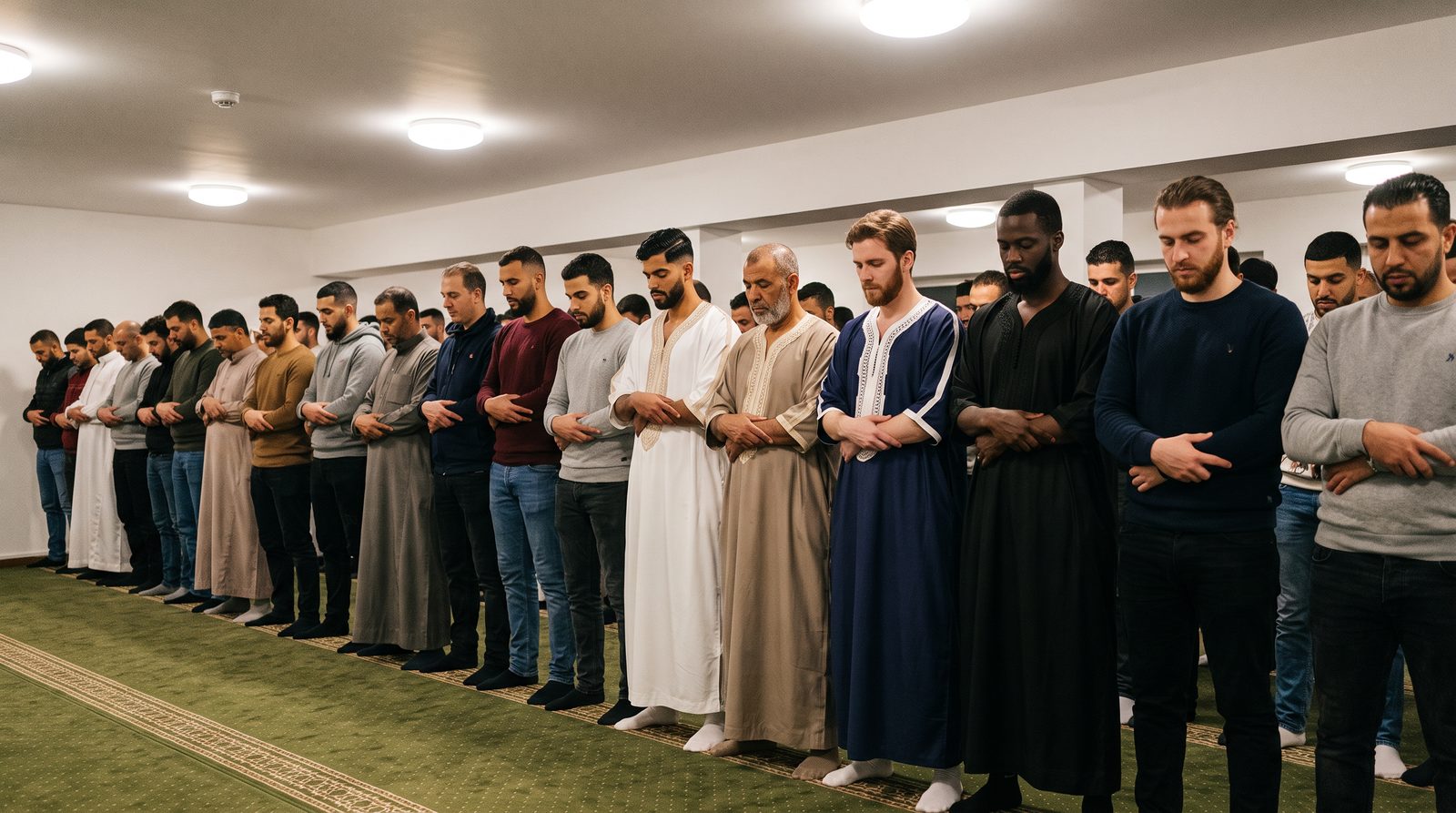
During Ramadan, the tarawih are prayed every evening at the mosque, often shoulder to shoulder in packed halls. The ideal outfit is mestour, loose and light. The Moroccan Thobe is the natural choice for its freedom of movement, while the djellaba is kept for the cold outside. We also explain the meaning of the fast, how an evening unfolds, the last ten nights, the Night of Decree and the Eid celebration.
The blessed month
What is Ramadan?
Ramadan is the ninth month of the Hijri calendar, the month in which the Quran began to be revealed. Muslims fast from dawn to sunset, and the nights are filled with prayer. Fasting during Ramadan is one of the five pillars of Islam.
The month begins with the appearance of the crescent moon, which is why it moves forward by about eleven days each year. In 2027, it is expected around Monday, February 8, according to astronomical calculations, with Eid al-Fitr around March 9 or 10. The exact date depends on the sighting of the crescent, and each country announces it the evening before.
In Europe, Ramadan 2027 will therefore fall in the middle of winter. Fasting days will be short, around eleven hours in Paris, but the evenings will be cold. That detail matters when choosing what to wear, and we come back to it below.
“The month of Ramadan is the one in which the Quran was sent down as guidance for people.”
Surah Al-Baqarah, verse 185
The meaning of the fast
Is fasting only about not eating?
No. During Ramadan, you abstain from eating and drinking from dawn to sunset, but also from lying, cheating, speaking ill of others and losing your temper. According to most scholars, these faults do not require you to make up the day, but they can strip the fast of its reward.
Ramadan is a month of self-discipline. You learn to hold your tongue as much as your hunger, to be more patient at work, gentler at home and more generous with those who have less. A fast that changes nothing in your behavior misses the point, and the Prophet said so very clearly.
That is also why many people use this month to drop a bad habit, get back to praying on time or reconnect with a loved one.
“Whoever does not give up false speech and acting upon it, Allah has no need of his giving up his food and drink.”
Reported by Al-Bukhari, no. 1903
The month of the Quran
Why is the Quran read so much during Ramadan?
The Quran is read a great deal during Ramadan because it is the month in which it began to be revealed. Muslims strive to read it in full at least once during the month, and to listen to it every evening during the tarawih. Every letter read counts, and the reward for good deeds is especially great in this month.
The angel Gabriel reviewed the Quran with the Prophet every Ramadan, and that is where the tradition of reading it in full during the month comes from. Many read one hizb or one juz' a day, while others make use of their commute or their lunch break, which the fast leaves freer.
The fast itself holds a special place. In a hadith reported by Al-Bukhari and Muslim, Allah says that every deed of the son of Adam is for himself, except fasting, which is for Him, and He Himself gives its reward.
“Whoever reads a letter from the Book of Allah receives a good deed, and a good deed is multiplied tenfold.”
Reported by At-Tirmidhi, no. 2910
The nights of Ramadan
What are the tarawih?
The tarawih are voluntary prayers specific to the nights of Ramadan. They are prayed after isha, in congregation at the mosque, behind an imam who recites the Quran so as to complete it in full, often on the 27th night. It is a strongly recommended sunna, but it is not obligatory.
The word tarawih comes from the idea of rest, because a pause is taken after every four units. The Prophet prayed them in congregation with his companions for a few nights, then continued alone, for fear they would become obligatory. It was the caliph Umar who later gathered the faithful behind a single imam at the mosque, a practice that has continued to this day.
In Moroccan mosques, eight rak'a are prayed in four sets of two, followed by the chaf', two rak'a, and the witr, a single rak'a. Nothing obliges you to stay until the end, and you can pray two, four, six or all eight depending on your strength. Each evening, the imam recites part of the Quran so as to complete the khatma, the full reading, around the 27th night.
The tarawih are known as an evening prayer after isha, but the most dedicated also come back to pray before fajr, especially during the last ten nights. In Europe, many mosques bring in imams from Morocco, Algeria or Tunisia for the month, chosen for the beauty of their recitation.
“Whoever prays during the nights of Ramadan out of faith and hoping for Allah's reward will have his past sins forgiven.”
According to Al-Bukhari and Muslim
Here is how a Ramadan evening unfolds, from breaking the fast to the pre-dawn meal.
Breaking the fast
The fast is broken as soon as the maghrib call to prayer is heard, simply, as the Prophet did, before sitting down to eat.
The maghrib prayer
Maghrib is prayed at home or at the mosque, and then the meal is finished at a relaxed pace.
The isha prayer
You head to the mosque for isha. This is the time to put on your prayer outfit.
The tarawih
The heart of the evening. Eight rak'a, prayed in four sets of two, with a long recitation of the Quran. You can stop after two, four or six.
The chaf' and the witr
After the tarawih comes the chaf', two rak'a, then the witr, a single rak'a, with the imam's supplication.
Suhoor and fajr
The most dedicated go back to pray the tarawih before fajr, then have a last date and a glass of water before the prayer. At home, suhoor ends ten to twenty minutes before fajr, and then you pray.
The outfit
What should you wear to pray at the mosque during Ramadan?
To pray at the mosque, a man wears a mestour outfit, meaning one that covers at least from the navel to the knees, and that is loose, clean and not see-through. During Ramadan, people take a little more care with their clothes, since every evening they stand before God and before the whole community.
In darija, mestour means covered and modest. A mestour outfit does not show the shape of the body, does not ride up the back when you prostrate and does not bother your neighbors in the row. Jeans and a T-shirt are fine for everyday wear, but after thirty evenings of prayer in a row, you understand why traditional clothing was designed with prayer in mind.
In Morocco as in the diaspora, many people buy a new outfit for the month, often a Moroccan Thobe or a djellaba, which they then keep for the 27th night and for Eid. A light fragrance completes it, and musk remains a classic.
“O children of Adam, take your adornment at every place of prayer.”
Surah Al-A'raf, verse 31
Our Moroccan Thobes for the tarawih
Light, loose, no side slits


The right choice
Moroccan Thobe, qamis or djellaba, which should you choose for the tarawih?
In Europe, the qamis is still the most widely worn prayer garment, but in recent years the Moroccan Thobe has made a strong comeback because it is more practical. Its short, wide sleeves make ablutions easier, its loose cut lets you move freely, and its light fabric stays comfortable in a full mosque. It is the ideal outfit for the tarawih and for everyday prayer.
In Europe, many neighborhood mosques are modest prayer halls, and during Ramadan they overflow. People pray shoulder to shoulder, the rows stretch into the hallways, and it quickly gets hot. In a djellaba with its hood, you feel stifled and take up space. The Moroccan Thobe, on the other hand, goes unnoticed, and that is exactly what you need from it to get through a whole evening of prayer.
The qamis is a long tunic with long sleeves and a collar, worn mainly in the Gulf and the Middle East. The Moroccan Thobe is its North African cousin, looser, with short sleeves and an embroidered chest panel. Jabador.com Moroccan Thobes have no side slits, so they keep you covered when you sit or prostrate. The djellaba is the long hooded garment, made for going outdoors.
| Moroccan Thobe | Qamis | Djellaba | |
|---|---|---|---|
| Sleeves | Short and wide | Long, often with cuffs | Long and wide |
| Ablutions | You keep it on | You roll up the sleeves | You roll up the sleeves |
| Packed mosque | Light, takes up little space | Fine | Warm and bulky |
| Sides | Closed, no slits | Depends on the model | Closed |
| Origin | North Africa | Gulf, Middle East | North Africa |
| In Europe | Back in recent years | The most widely worn | Mostly in winter |
| Ideal for | The tarawih and everyday prayer | Everyday prayer | Cold evenings |
Winter
What should you wear for the tarawih when it is cold?
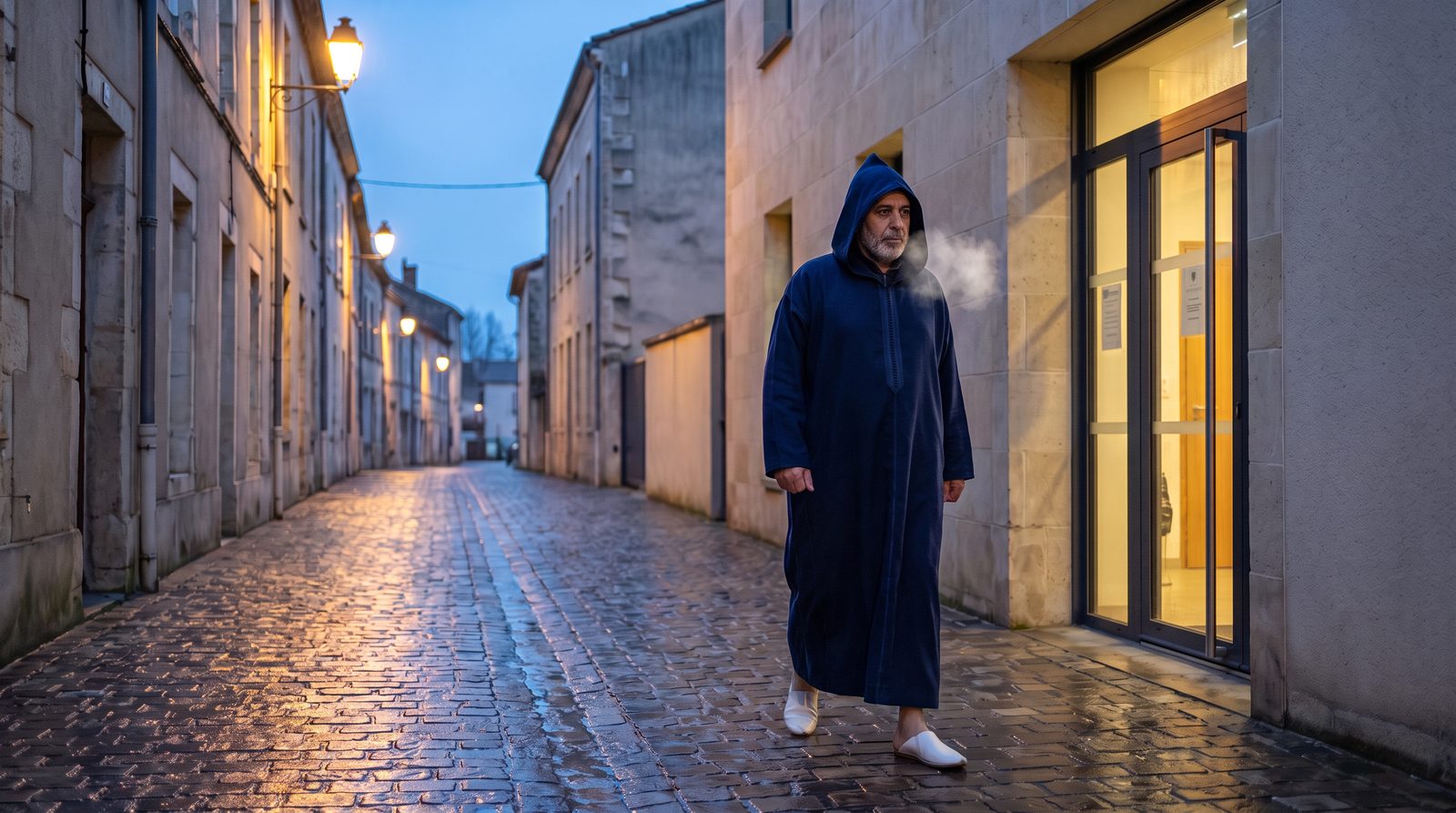
When Ramadan falls in winter, you don't go out in just a Moroccan Thobe. You wear a warm djellaba, in gabardine, thick mlifa or cashmere-style fabric, with a qamis or a farajiya underneath rather than a Moroccan Thobe. That way, you can take off the djellaba if the mosque is overheated and still pray properly dressed.
Gabardine blocks the wind and handles rain, mlifa, a thicker wool-blend fabric, keeps you warm in very cold weather, and cashmere-style fabric, a blend rather than pure cashmere, is the softest. Dark shades such as midnight blue, black or taupe are the most practical, as they hold up to a whole month of comings and goings.
Under the djellaba, you never wear a Moroccan Thobe, but a qamis or a farajiya, the long, fine tunic with long sleeves. If the hall is too warm, you take off the djellaba and remain properly dressed to pray. Those who are attached to their Moroccan Thobe keep it on with a jacket over it for the journey.
For winter evenings
Gabardine djellabas


The last third
What happens during the last ten nights of Ramadan?
The last ten nights of Ramadan are the most precious of the month. The Prophet would increase his worship during them, stay up for much of the night and wake his family to pray. It is within these nights that Laylat al-Qadr, the Night of Decree, is hidden.
Mosques stay open later, and many hold qiyam, a late-night prayer before suhoor. The most devoted perform i'tikaf, a spiritual retreat at the mosque for all or part of these ten days. For everyone, it is the time to increase supplications, Quran reading and charity, and to pay zakat al-fitr before Eid.
The Night of Decree is sought above all in the odd-numbered nights, the 21st, 23rd, 25th, 27th and 29th.
It is also the period when many people leave to perform Umrah. The Prophet said that an Umrah performed during Ramadan is equal to a Hajj, and in one narration, to a Hajj performed with him. To help you prepare, we have written a guide on what to wear for Umrah.
“When the last ten nights arrived, the Prophet would tighten his waist wrap, stay up through the night and wake his family.”
According to Al-Bukhari and Muslim
The Night of Decree
Is the 27th night necessarily Laylat al-Qadr?
No, nobody knows the date of Laylat al-Qadr with certainty. The Prophet asked us to seek it in the odd-numbered nights of the last ten nights of Ramadan. The 27th night is the most often mentioned, but it is not guaranteed.
Laylat al-Qadr is the night on which the Quran began to be sent down, a night the Quran describes as better than a thousand months, or more than 83 years. The companion Ubayy ibn Ka'b swore that it was the 27th night, which explains its special place. Ibn Mas'ud, for his part, refused to fix it, so that no one would ease their efforts on the other nights. The scholar Ibn Hajar listed more than forty opinions on its date.
The wise approach is therefore to stay up on each of the odd-numbered nights, putting a little more into the 27th. The supplication the Prophet taught Aisha for this night is simple, “Allahumma innaka ‘afuwwun tuhibbu l-‘afwa fa‘fu ‘anni,” O Allah, You are the One who pardons and You love to pardon, so pardon me.
“Seek the Night of Decree in the odd-numbered nights of the last ten nights of Ramadan.”
According to Al-Bukhari
Lilat 27
How is the 27th night observed in North Africa?
In Morocco and across the North African diaspora, the evening of the 26th to the 27th of Ramadan is a special one. Mosques are full for the end of the khatma, families gather, and children doing their first fast are dressed in traditional clothes and celebrated.
For many children, it is their first full day of fasting. They are congratulated and photographed in their Moroccan Thobe or little kaftan, and the girls often have henna on their hands. Families come together, give charity, and then the men head to the mosque for a long night of prayer, sometimes until dawn.
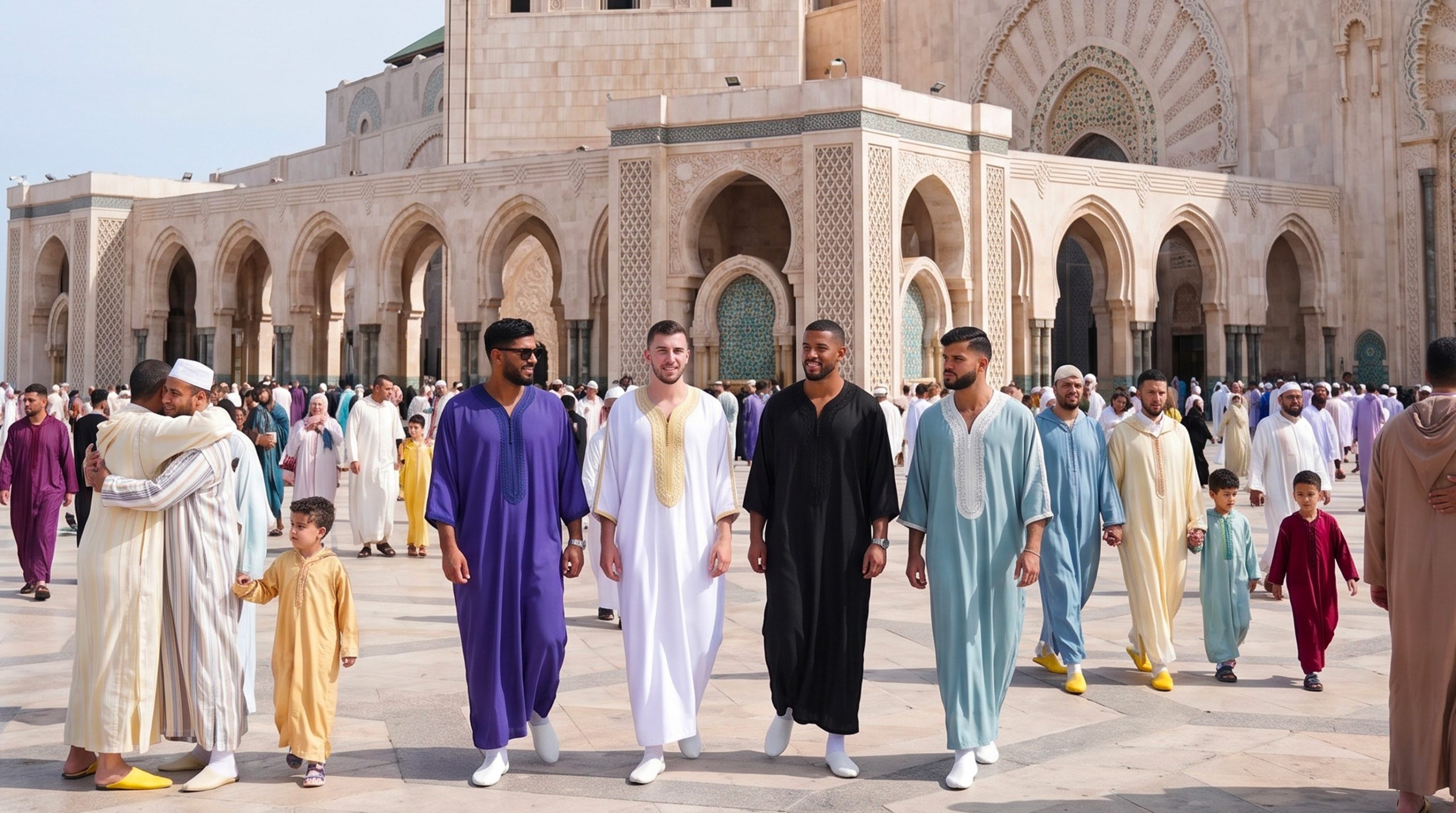
As for clothing, men often bring out their finest Moroccan Thobe, white or light-colored, as a foretaste of Eid. It is also a chance to match father and son for the family photo.
For the 27th night
Light shades, as a foretaste of Eid


The end of the month
How does Ramadan end?
Ramadan ends after 29 or 30 days of fasting, when the crescent moon of the following month appears. The next day is Eid al-Fitr, the festival of breaking the fast, also called the Ramadan festival or Aïd seghir in North Africa. In 2027, it is expected around March 9 or 10.
In France, the date is announced the evening before, on the night of doubt, after the crescent has been sighted. Before the Eid prayer, each family pays zakat al-fitr for every one of its members, children included, a charity that allows those with the least to celebrate too. It is given in food, one sa', about 2.5 kg (5.5 lb) of a staple such as wheat, barley, rice or semolina, which is what the Maliki school followed in North Africa prefers, or in money. In 2026, the amount was €9 per person in France according to the CFCM, and 25 dirhams in Morocco. Each year's amount is announced before the end of Ramadan. In the morning, you perform the full ablution, put on a new outfit or your finest clothes, and head to the Eid prayer reciting the takbir.
The day continues with family, between visits to relatives and gifts for the children. For that morning's outfit, often light-colored and carefully chosen, we have written a complete guide, what to wear for Eid al-Fitr.
For other occasions
Dressing for other moments of faith
After Ramadan comes Eid al-Fitr, and then life returns to its usual rhythm, with Friday prayer every week and, for some, Umrah. Each occasion has its own codes, somewhere between restraint and elegance.
We've put together guides dedicated to every moment, to help you choose the right outfit at the right time.


The right outfit at the right time
For Ramadan as for the rest of the year, every Jabador.com piece is made in our workshops in Morocco. Choose a Moroccan Thobe that suits you and live this blessed month with peace of mind.
Discover our Moroccan ThobesYou wonder
Frequently asked people ask
What should you wear for the tarawih?
A loose, clean, mestour outfit that covers at least from the navel to the knees. The gandoura is the most practical choice, since its short sleeves make ablutions easier and it stays light in a crowded mosque. In winter, add a djellaba for the journey there and back.
Can you pray the tarawih in a djellaba?
Yes, the djellaba is perfectly suited to prayer. In a packed mosque, though, it can get warm. In winter, wear it over a qamis or a farajiya so you can take it off when you arrive, like the midnight blue djellaba in gabardine.
How many units does the tarawih prayer have?
Eight rak'a, prayed in four sets of two, followed by the chaf', two rak'a, and the witr, one rak'a. The tarawih are not obligatory, so you can pray two, four, six or eight.
Does lying break the fast?
According to most scholars, lying does not require you to make up the day, but it can cost you the reward of the fast. The Prophet said that Allah has no need for a person to give up food and drink if that person does not give up lying, a hadith reported by Al-Bukhari.
Is an Umrah during Ramadan equal to a Hajj?
The Prophet said that an Umrah during Ramadan is equal to a Hajj, and in one narration, to a Hajj performed with him, according to Al-Bukhari and Muslim. It does not, however, replace the obligatory Hajj. Our guide on what to wear for Umrah will help you prepare.
How much should you give for zakat al-fitr?
One sa' of food per person, about 2.5 kg (5.5 lb) of wheat, barley, rice or semolina, or its equivalent in money. In 2026, the CFCM set it at €9 per person in France, and Morocco at 25 dirhams. It must be paid before the Eid prayer.
Does the Night of Decree always fall on the 27th day of Ramadan?
No. Its exact date is not known. It is recommended to seek it in the odd-numbered nights of the last ten nights, with the 27th being the most often mentioned, though it is not certain.
What is Eid al-Fitr, the celebration that ends Ramadan?
Eid al-Fitr is the celebration that marks the end of Ramadan, on the day after the last day of fasting. It begins with zakat al-fitr and a congregational prayer in the morning, then continues with family. Everything you need to know about what to wear that day is in our guide to the Eid al-Fitr outfit.
When does Ramadan 2027 begin?
According to astronomical calculations, Ramadan 2027 should begin around Monday, February 8, 2027, with Eid al-Fitr falling around March 9 or 10. The exact date depends on the sighting of the crescent moon.