Moroccan traditions

Moroccan Wedding

Moroccan wedding
In summary

The Moroccan wedding is experienced over several days, from the henna to the grand celebration, with its outfits, jewelry, and rituals that change from one region to another. We tell you how it really happens, what the bride wears, what the groom puts on, and the outfits that accompany each moment of the celebration.

An exceptional celebration

Moroccan Wedding: Outfits and Traditions

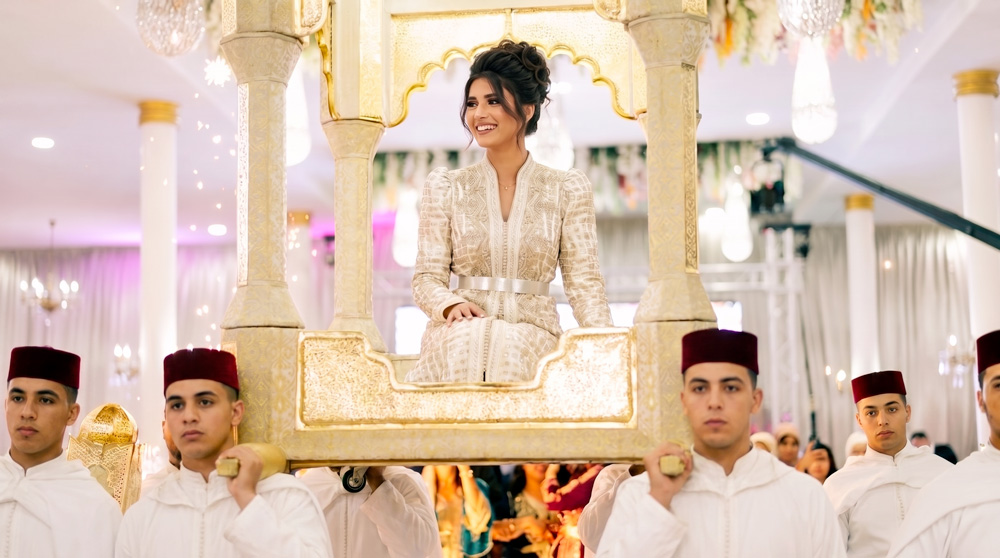
The Moroccan wedding is not limited to a single evening. Once the engagement and the khotba have passed, often several weeks or even several months earlier, the celebration itself takes place over one to three days, centered around two main highlights: the henna night and then the grand reception where the bride appears on the amariya.

What often surprises guests from elsewhere is the pace. Nothing is rushed. The main reception starts late and can last until the early hours of the morning, with dinner served around midnight and a bride who changes outfits throughout the night. Behind this apparent freedom, everything is framed by precise codes, carried out by a central figure, the negafa, who dresses the bride and orchestrates every appearance. From one family to another, sometimes all the steps are kept, sometimes only the most striking ones, but the spirit remains the same: bringing the two families together around a generous celebration.

Moroccan amaria

The schedule

What is the step-by-step process for a Moroccan wedding?

The Moroccan wedding takes place in several stages, from the khotba which seals the agreement up to the big party. Here are the main steps, in order.

1▼
Before the nikah

The khotba

We agree on this. The two families set the dowry, the date, and the arrangements, with no exchange of gifts at this stage. In addition to the dowry, two or three high-end takchitas and some gold jewelry are often bought.

2▼
Officialization

The nikah certificate

A more intimate ceremony where the adoul, the state-approved officiant, draws up the certificate in the presence of two witnesses. On paper, the couple is united.

3▼
The preparations

The bride's hammam

The bride goes to the hammam for a purifying bath, surrounded by the women of her family, amidst songs and ululations.

4▼
The day before

The Henna Night

The henna brings loved ones together. The nekacha draws patterns on the bride's hands and feet, a pledge of prosperity.

5▼
The procession

The Hdia

The groom's family has the hdia brought, this procession of gifts announced by songs, fabrics, sugar, dates, milk, and perfumes.

6▼
The big day

The big evening

The negafa dresses the bride in her heavy jewelry before the couple enters on the amariya. Dinner is around midnight, the bride changes outfits throughout the night, and the party continues until the very end.

7
The next day

La Sbahiya

The next day, the bride's family brings a festive meal—harira, chebakia, and dates—and close relatives come to see her in her new home. It is also the time for the hdiya, the gifts from the husband and his in-laws.

The council

If you get married in Europe, remember to have at least two male witnesses on the day of the ceremony. This is what makes it possible to later establish a Moroccan family record book. Without this, you will have to return to the consulate with two witnesses to regularize the situation.

Bride's side

What does the Moroccan bride wear?

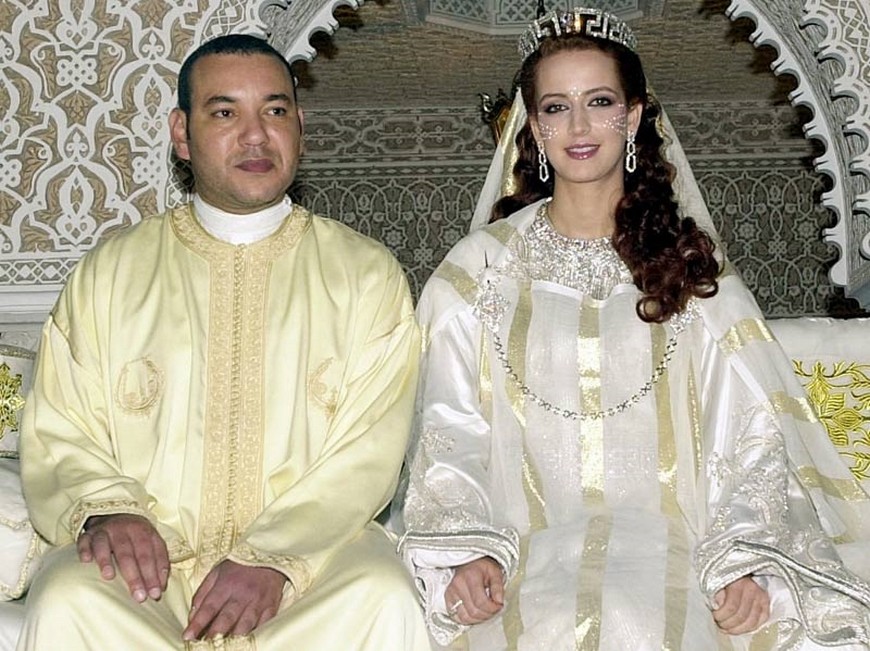
A Moroccan bride doesn't wear just one dress—she wears several. Over the course of the evening, she may change into as many as seven outfits, each representing a different region of the country. The kaftan and the takchita are always present, cinched at the waist by the mdamma, an embroidered belt that defines the silhouette.

The most impressive piece remains the chedda, a ceremonial outfit richly adorned with embroidery and jewelry, the Fassi version of which is the most renowned in the kingdom. The takchita, on the other hand, consists of two layers: a simple dress covered by a second, more elaborately crafted one. The kaftan is a single-piece garment suitable for both the henna ceremony and the reception. Between each outfit, the negafa touches up the bride’s hairstyle, jewelry, and makeup. A detail that many are unaware of is that these dresses do not belong to the bride; they belong to the negafa, who provides them for the evening. The takchitas and caftanss that are purchased, on the other hand, are worn by the guests, sisters, and mothers of the bride and groom.

Groom's side

How is the groom dressed?

For the grand celebration, the groom can choose from several ceremonial outfits: a kaftan, a three-piece jabador, or a white djellaba—sometimes white and gold—with a two-piece jabador worn underneath. The two-piece jabador alone is reserved for the engagement and the hlal—the religious wedding—not for the main celebration.

White and gold dominate to mark the occasion, but midnight blue, green, and burgundy also have their place. Often, the bride chooses the color of the groom’s kaftan or jabador to match one of the outfits she has selected from the negafa. The selham—a large hooded coat—complements the ensemble for the grand entrance.

On the evening of the henna ceremony, the bride often wears green, and the groom follows suit, wearing a green jabador, a kaftan, or a simple green velvet tunic. Many Moroccans living in Europe wear a suit to the town hall, with a selham over it, to add a traditional touch.

The sets of jewelry

The bride's jewelry

Moroccan bridal jewelry varies from one region to another. Gold and pearls reign in Fes and Rabat, solid silver among the Amazighs of the Souss, and amber and chased silver in the Sahara.

Everywhere, these sets of jewelry are passed down and rented from generation to generation, and the negafa adjusts them to each outfit. For region-by-region details, from the chedda fassia to the Amazigh fibulae, explore the dedicated guides of Fassi wedding at Shilha wedding.

The atmosphere

The Music of wedding

Music makes the wedding, and each region has its own. Andalusian tarab al-ala in Fez, gharnati and reggada in Oujda, taktouka jabaliya in the North, aïta and chaâbi in Casablanca, dakka marrakchia in Marrakech, ahwach among the Amazighs, guedra in the Sahara.

From the most refined Andalusian orchestra to the most lively reggada, the soundtrack tells where the family comes from. Depending on the family, they choose a traditional orchestra, a group of chikhate, or a DJ to animate the evening. Each regional tradition is detailed in its guide, from Oujda wedding at Marrakesh wedding.

Dinner is served

The wedding Meal

The traditional Moroccan wedding dinner revolves around two flagship dishes: roast chicken followed by meat tagine with prunes. With the evolution of receptions, the whole chicken often gives way to a pastilla as a starter, made with chicken or seafood, followed by the main course, and then comes the time for dessert and the large fruit platter.

Regional signatures make all the difference: the pigeon pastilla from Fez, the fish for weddings in the North, the tagine in the Souss, the mechoui in the South, the tanjia of Marrakesh. The mechoui, a whole roasted lamb or sheep, everywhere embodies that same spirit of generosity.

Moroccan wedding caterer

The place

Function room, rooftop terrace, or tent?

The wedding venue depends a lot on the budget. Large receptions are held in a banquet hall, also known as a wedding hall, where a caterer takes care of the entire meal. Other families host on a stah, the terrace, or under a tent set up in the neighborhood.

In wedding halls, the caterer handles everything, from pastilla to méchoui, with meticulous service. For tighter budgets, it is the tayabate, traditional female cooks, who prepare the meal at home or under a tent, helped by the women of the family. Hall, rooftop, or tent, the essential thing remains the generosity of the table and the welcoming of guests.

The female conductor

The negafa, guardian of traditions

The negafa is the key figure of the wedding. She dresses the bride, provides the outfits and jewelry, coordinates the appearances, and ensures that the rituals are respected throughout the evening.

Much more than a dresser, she is the guardian of traditions and the bride’s companion on the big day. In the north, in Tangier and Tetouan, she is called the ziana, from zine, meaning beauty, in reference to her role as an embellisher. Hiring a negafa ensures that nothing is missing, from the jewelry to the ritual gestures.

From one region to another

Traditions vary by region

There isn't just one Moroccan wedding, but dozens. In Fez, the chedda reigns, inherited from the great families of the medina. Among the Souss Chleuhs, the silver of Amazigh jewelry dominates. In Rabat, Oujda, Tangier, or the Sahara, each procession has its own accent, songs, and colors.

These differences are not mere details. They tell the story of each region, its Andalusian, Amazigh, or Saharan influences, and the way families transmit their identity. The bride from the North does not adorn herself like the one from Souss, and the rituals surrounding henna vary just as much. If your in-laws come from a specific region, or if you simply want to understand what you will see on the big day, explore the traditions city by city. We have detailed each of them in a dedicated guide.

On the guest side

What do guests wear to a Moroccan wedding?

At Moroccan mariages, guests combine traditional attire with elegant evening wear. Many women wear a kaftan or a takchita, while men wear a djellaba, a jabador, or a fine suit. Immaculate white and dazzling gold, however, remain the exclusive domain of the bride and groom.

This is a common source of curiosity among guests from other places—a non-Moroccan groom-to-be, a new convert, or the younger generation, who are less familiar with these customs. In reality, the atmosphere is more welcoming than formal. A man wearing a jabador or a djellaba blends in naturally, and many take the opportunity to show off a beautiful outfit. The colors are vibrant, ranging from midnight blue to burgundy, while the bride and groom stick to white and gold. It’s also an opportunity to treat yourself to an outfit you’ll wear again—a beautifully crafted djellaba or a simple jabador that will last through the seasons.

You wonder

Frequently Asked Questions

The celebration itself focuses on one to three days, between the henna night and the main party. The engagement and the khotba, on the other hand, usually took place several weeks or months earlier. The main party starts late and often lasts until the early morning hours.

Most men opt for a djellaba, a jabador, or a nice suit. Pristine white and gold remain the exclusive domain of the bride and groom, but other colors are also welcome. Many look to the jabador man.

Yes, it is a strong tradition. The bride can change her outfit up to seven times throughout the night, with each dress often reflecting a region of Morocco. The negafa helps her change from one outfit to another.

Of course. Wearing traditional clothing is seen as a sign of respect, not cultural appropriation. Many non-Moroccan guests and new converts choose to wear a kaftan or a jabador for the occasion, and it’s always appreciated.

For the big night, the groom wears a kaftan, a three-piece jabador, or a white djellaba—sometimes white and gold. On the evening of the henna ceremony, he often wears green—either a jabador or a green velvet tunic. White, gold, midnight blue, and burgundy are the dominant colors.

For an item in stock, a few days are enough depending on the delivery. During the peak wedding season, allow two to three weeks for a high-demand model, just to avoid stockouts.

The negafa is the key figure in a Moroccan wedding. She dresses the bride, provides the outfits and jewelry, coordinates the appearances, and ensures that the rituals are respected. In the north, in Tangier and Tetouan, she is called the ziana.

Both are done. A traditional orchestra or a chikhate group for an authentic atmosphere, or a DJ for a modern party. Many weddings combine both.

2 Replies to “Mariage Marocain”

  1. Guenaoui

    Hello, how much is the jabador men's outfit and do you have any other models?

    1. Rachida

      Hello, the jabador is the perfect outfit for a Moroccan wedding. You can find all our models here. https://www.jabador.com/boutique/jabador-homme/

Join the conversation

Login
Password Recovery

Lost your password? Please enter your username or email address. You will receive a link to create a new password via email.

Cart 0