
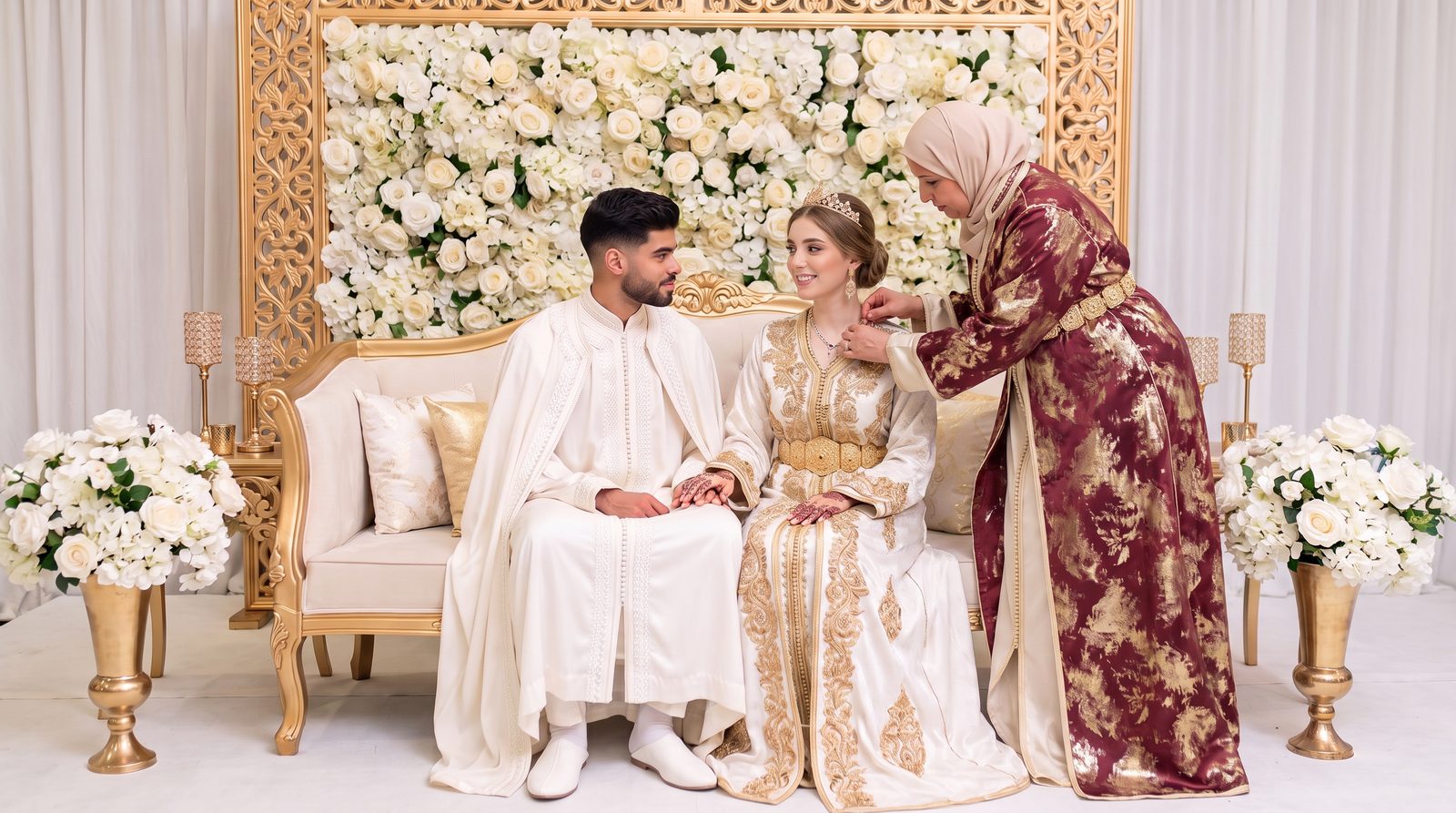
The negafa, or neggafa, called ziana in the North, is the woman who dresses the Moroccan bride and orchestrates her appearances on the wedding day. She rents out the outfits and jewelry, manages the entrance on the amariya and the outfit changes, often three to seven during the evening. This guide explains her role, her history, the outfits by region, her prices in Morocco and in Europe, and how to choose the right one.
Her role
The negafa, guardian of traditions
The negafa is the professional who prepares and accompanies the bride throughout her wedding. She provides the traditional outfits and jewelry, often the gelsa and the amariya too, dresses the bride and manages every outfit change. It is also spelled neggafa or nggafa, and in northern Morocco she is called the ziana.
She is much more than a dresser. The negafa is costume designer, stylist and stage director all at once. She knows the order of the outfits, the meaning of the adornments, the moment when the bride must appear and the moment when she must withdraw. She is the one who makes sure nothing is missing, from the jewelry to the gestures of tradition.
The word comes from Moroccan dialect, nggafa in Amazigh. Its exact origin is still debated, with some linking it to Amazigh and others to Arabic. The outfits the bride wears that evening almost always belong to the negafa, who rents them out for the night.
The names
Negafa or ziana, what is the difference?
Negafa and ziana refer to the same profession. Negafa is the most common word in Morocco, while ziana or ziyana is the word used in the North, from Tangier and Tetouan to the Rif. It is also the word most used in Belgium and the Netherlands, where many families come from northern Morocco.
Ziana comes from zine, beauty, so the ziana is the one who makes the bride beautiful. In Amsterdam, The Hague or Brussels, people search for a ziana far more often than for a negafa. In France, many professionals display both words, negafa ziana, so that every family can find them. In the Sahara, people tend to speak of the m'aalma, and for an Algerian wedding, of a dresser or an Algerian negafa.
The history
Where does the negafa profession come from?
The negafa profession is very old in Morocco, especially in the imperial cities. In the early 20th century in Fès, negafas formed a genuine guild, with a head called the amina, master dressers called ma'llma, assistants and apprentices. The know-how was passed down through apprenticeship, often from mother to daughter.
The historian Roger Le Tourneau describes this organization in La vie quotidienne à Fès en 1900. Each ma'llma led three to five assistants and some apprentices, and the largest teams could number around forty people. Like the other trades of the medina, they answered to the muhtasib, the official who oversaw the guilds. At the same time, the painter Josep Tapiró, who lived in Tangier from 1880 to 1913, painted these women dressing brides.
Today, the profession has grown younger. Many negafas are also designers who create their own kaftans and run a showroom for brides and their guests. They work with social media, release collections every season, and a few men have even entered the profession.
The big day
What does the negafa do on the wedding day?
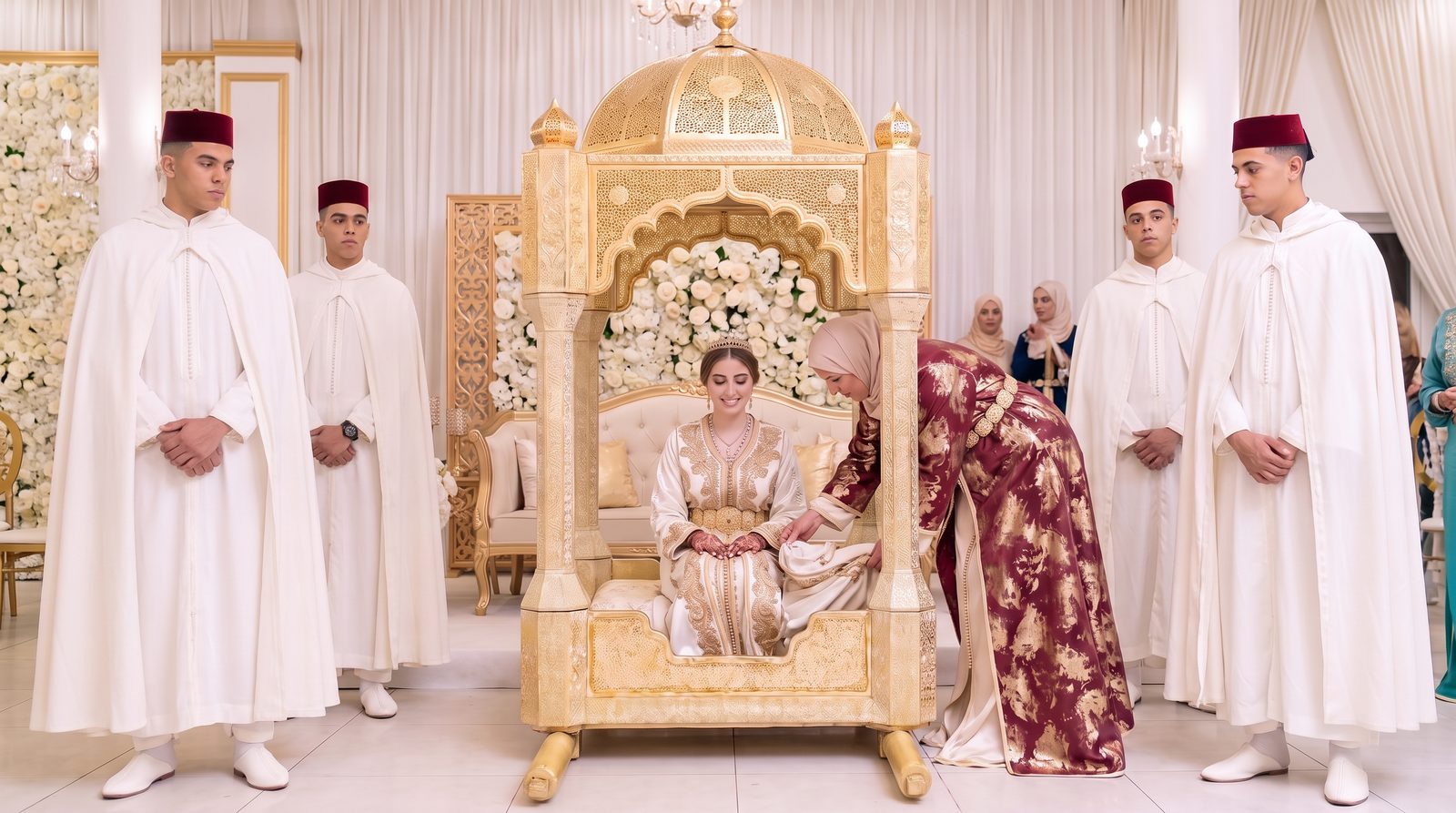
On the wedding day, the negafa dresses the bride, adorns her with her jewelry and brings her in on the amariya, the palanquin carried by four to eight men. She then handles the series of outfit changes, touches up hair, jewelry and makeup, and coordinates each appearance with the band or the DJ.
The negafa often brings the gelsa, the seating area where the couple sits, with its sofa or thrones, and the amariya with its bearers. The decoration of the venue, the tables and the tableware are usually handled by the caterer.
Her work begins months before the celebration, with the fittings, and can also cover the henna night. Here is how a full service unfolds, from booking to the end of the night.
Booking
Well-known negafas are booked very early, especially for summer Saturdays. You sign a contract and pay a deposit.
The fittings
The bride chooses her outfits in the showroom, and the negafa takes her measurements and plans the alterations.
The henna party
Many negafas also dress the bride for the henna night, often in green.
The entrance on the amariya
The bride, in her first outfit, is carried in on the amariya to the sound of youyous, with the groom at her side.
The outfit changes
Three to seven outfits, each with its own jewelry. Between two appearances, the team adjusts everything in a few minutes.
The last appearance
Often a white outfit or a modern gown, before the negafa collects the outfits and jewelry.
The regions
Which outfits does the negafa dress the bride in, region by region?
Every region of Morocco has its own bridal outfit, and a good negafa knows them all. Fès has the chedda fassia, Rabat the blue rbatia, the North the chedda chamalia, the Oriental region the blousa oujdia, the Sahara the melhfa, and the Souss its silver Amazigh adornments. The bride often wears several of them during the evening.
Many brides take a tour of Morocco in a single night, with an outfit from their home region, one from their husband's region, and then more modern outfits. The table below summarizes the main regional outfits.
| Region | Signature outfit | What sets it apart |
|---|---|---|
| Fez | Chedda fassia, or lebsa del joher | Gold embroidery, pearls, taj and mdamma, the most noble outfit in the kingdom |
| Rabat | Rbatia and takchita mansouria | Deep blue kaftan, silver embroidery, crystal jewelry |
| Tangier, Tetouan | Chedda chamalia | Floral headdress, Andalusian details, necklaces by the dozen |
| Oujda, the Oriental region | Blousa oujdia, or keswa | Dress of the Oriental region, often followed by a chedda chamalia |
| Marrakech | Takchitas and taj | Heavy jewelry covering the chest |
| The Souss | Amazigh outfit | Silver jewelry and fibulae |
| The Sahara | Melhfa | Long wrapped veil in bright colors, prepared by the m'aalma |
Today, negafas also add outfits from elsewhere, such as Indian or Gulf-style outfits, which are very popular with young brides. For details on each tradition, our guides to the Fassi wedding, from Rbati wedding and the Tangier wedding go further.
The groom
Does the negafa also dress the groom?
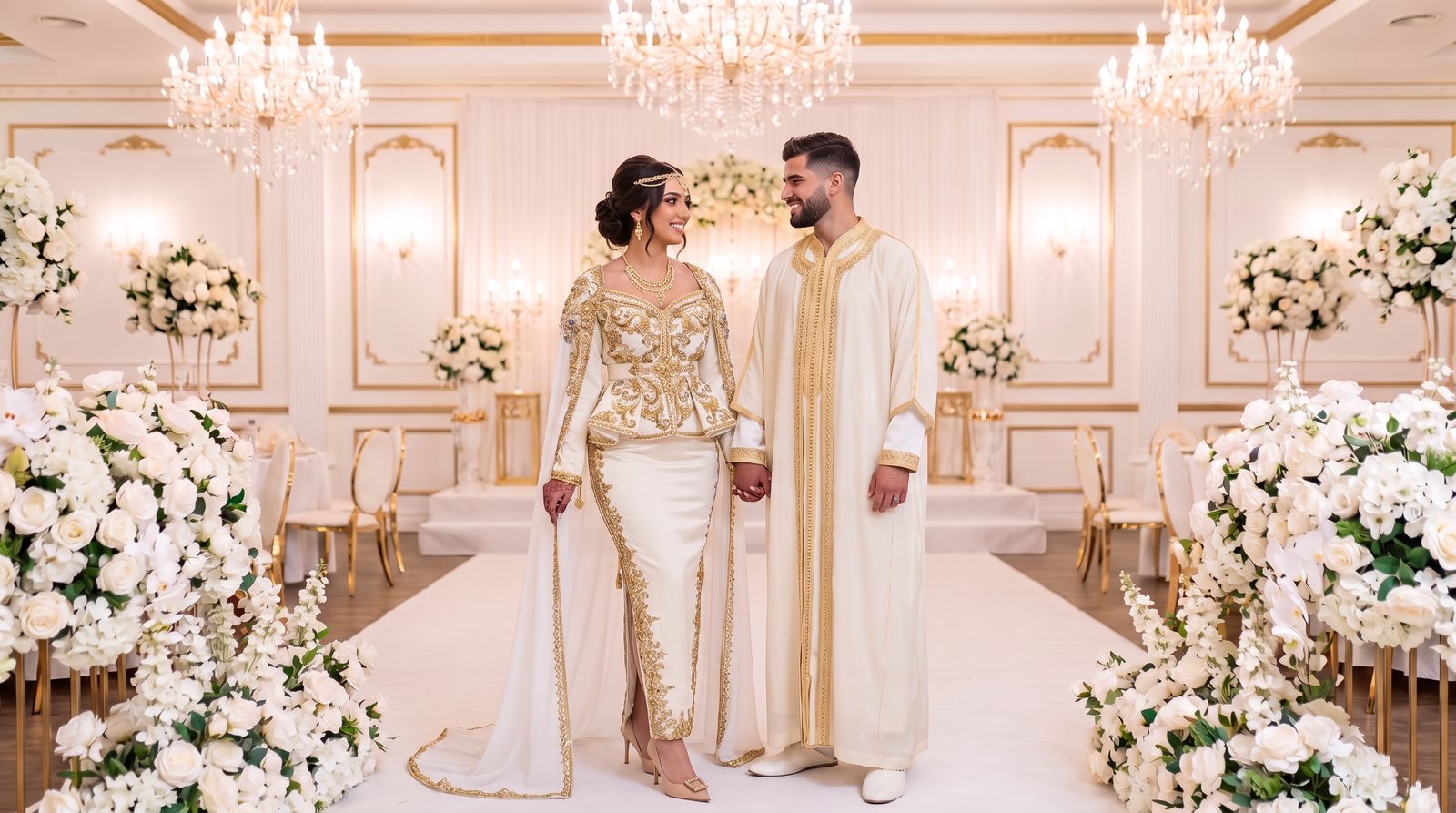
Some negafas also rent out outfits for the groom, but many grooms prefer to buy their own. The groom usually changes two or three times, kaftan, three-piece jabador or white djellaba, often with a selham over his shoulders. The color is chosen to match one of the bride's outfits.
Buying your outfit has two advantages. It fits you from the start, and you keep it after the wedding for Eid, a family celebration or a brother's wedding. The off-white Kaftan Wedding , with its chiffon cape and tone-on-tone embroidery, goes with every one of the bride's outfits. The Kaftan White and Gold echoes gold-embroidered takchitas.
For a blue rbatia, the Kaftan Blue and Gold echoes the bride. And for the other moments of the evening, a two-piece Jabador Wedding or a three-piece malaki jabador keeps you elegant without weighing you down.


Morocco and Europe
Negafa in Morocco or in Europe, what are the differences?
In Morocco, the negafa focuses on the bride, her outfits, her jewelry and the amariya. In Europe, many negafas offer a full service, with catering, venue decoration, sometimes the venue itself and the entertainment. Prices are also higher, with fewer outfits for the same budget.
In Morocco, the big houses have storefronts and collections renewed every season. Among the most frequently mentioned names are Majda Dar Benjelloun and Najoua Moustatir Tadlaoui. The high season runs from June to August, and many diaspora families celebrate their wedding there during the holidays.
In France, Belgium, the Netherlands or Spain, negafas are based near the large communities, in the Paris region, Lyon, Lille, Strasbourg, Brussels, Antwerp, Rotterdam or Amsterdam. Some bring their outfits over from Morocco, others travel with their suitcases. Quite a few of them, especially in Europe, offer the full catering service, which lets families deal with a single contact for the meal, the decoration and the bride. Be sure to check what the negafa does herself and what she hands over to partners.
More and more weddings also take place in fully equipped wedding venues that sell a package with every service, negafa, caterer, decoration, DJ, sometimes even the band. In that case, the negafa is often the venue's own, and it is worth seeing her outfits before signing.
North Africa
What is an Algerian negafa?
An Algerian negafa is a dresser who specializes in Algerian wedding outfits, such as the karakou of Algiers, the chedda of Tlemcen, the gandoura fergani of Constantine or the blousa of Oran. The word negafa comes from Morocco, but these professionals have multiplied recently, especially in France.
In Algeria, the bride parades in her outfits during the tasdira, the presentation of outfits, which can include up to seven. They honor her city, her roots, and sometimes the groom's. For a long time, it was mainly the women of the family who helped the bride change.
In recent years, dressers have been presenting themselves as Algerian negafas in Paris, Lyon or Lille. They rent out the outfits and jewelry and run the tasdira the way a Moroccan negafa runs her appearances. For mixed couples, some even offer an evening that combines Algerian and Moroccan outfits.
The budget
How much does a negafa cost?
In Morocco, a negafa costs from 8,000 dirhams for a simple service to more than 60,000 dirhams for a luxury house, according to prices gathered in Casablanca in 2026. In France, packages usually range from €1,500 to €5,000. The number of outfits, the jewelry and the amariya make the difference.
These amounts are rough estimates, and only a detailed quote lets you compare. The high season, from June to August, can add 20 to 30% to the price, and each additional outfit costs 2,000 to 5,000 dirhams in Morocco.
| Range | Indicative price | What is often included |
|---|---|---|
| Morocco, classic | 8,000 to 15,000 MAD | 3 outfits, simple jewelry, amariya, 1 or 2 assistants |
| Morocco, premium | 20,000 to 45,000 MAD | 4 to 6 outfits, quality gold-plated jewelry, bearers, 2 or 3 assistants |
| Morocco, high end | 45,000 to 60,000 MAD | Recent collections, crystal amariya with 8 bearers, makeup |
| Morocco, luxury | 60,000 MAD and up | One-of-a-kind or custom outfits, full staging |
| France | €1,500 to €5,000 | Depending on outfits, amariya, travel, hair and makeup |
Choosing well
How do you choose your negafa?
To choose your negafa, compare at least two or three quotes for the same service, see the outfits in person and ask for videos of recent weddings. Get everything spelled out in writing, the number of outfits, the jewelry, the bearers, the makeup, the deposit and the cancellation terms.
A photo shows neither the quality of a fabric nor the comfort of an outfit you will wear all night. Try on at least three outfits before signing, and ask for the opinion of brides who have worked with her.
Questions to ask before signing. How many outfits are included, and how much does an extra outfit cost? Is the jewelry gold or gold-plated? How many assistants and bearers will be there? Are makeup and hair included? How long does an outfit change take? Will she be there for the henna night? What happens if the wedding is postponed or canceled?
The profession
How do you become a negafa?
To become a negafa, you first need to learn from an established negafa, often for several years, and then build up a stock of outfits and jewelry. It is a trade learned through apprenticeship, with no required diploma, and it calls for real start-up capital.
Jewelry alone accounts for 30 to 40% of a professional negafa's capital, according to people in the trade in Morocco. She also needs outfits for every region, a team of assistants, an amariya and bearers. Many start out as assistants, then launch their own house with a few outfits and rent the rest at first.
Wedding guides
The negafa in each tradition
From one city to the next, the negafa does not dress the bride in the same outfits or in the same order. Our wedding guides detail the outfits, the jewelry and the sequence of each tradition, along with what the groom wears.
If you are preparing for the henna night, our guide to the henna night outfit also explains the neggafa's role that evening.


The right outfit at the right time
The negafa dresses the bride, and it is up to you to choose the outfit that answers hers. Every Jabador.com piece is made in our workshops in Morocco, in Fès and Casablanca.
Discover our men's kaftansYou wonder
Frequently asked people ask
What is the difference between negafa and ziana?
None in substance. Negafa is the most common word in Morocco, while ziana or ziyana is used in the North, in Tangier, Tetouan and Asilah. Both refer to the woman who dresses and adorns the bride.
How many outfits does the negafa have the bride wear?
Usually three to seven outfits during the evening, depending on the package chosen and the region. Simple packages include three, premium packages four to six, each with its own jewelry.
Does the negafa provide the gelsa and the amariya?
Often, yes. The negafa brings the gelsa, the seating area where the couple sits, and the amariya with its bearers. The decoration of the venue, the tables and the tableware are usually provided by the caterer.
Who pays for the negafa?
There is no single rule. Depending on the family, the negafa is paid by the bride's family, by the groom's family or by the couple. Today, it is more and more often the couple who book and pay for her.
When should you book your negafa?
Six to twelve months before the wedding for a summer date, sometimes a year for the most sought-after negafas. Off-season, from September to December, a few months may be enough.
Does the negafa provide the bride's jewelry?
Yes, the jewelry is almost always included and matched to each outfit, with crown, necklaces and belt. Ask whether it is gold or gold-plated, as that makes a big difference to the price.
How much does a negafa cost in France?
Usually between €1,500 and €5,000. The price depends on the number of outfits, the amariya and its bearers, travel, and hair and makeup. Some packages also include catering.
Can a negafa handle an Algerian wedding?
Yes. Algerian negafas offer the outfits of the tasdira, such as the karakou, the chedda of Tlemcen or the gandoura fergani, and some Moroccan negafas organize mixed evenings for Algerian-Moroccan couples.