
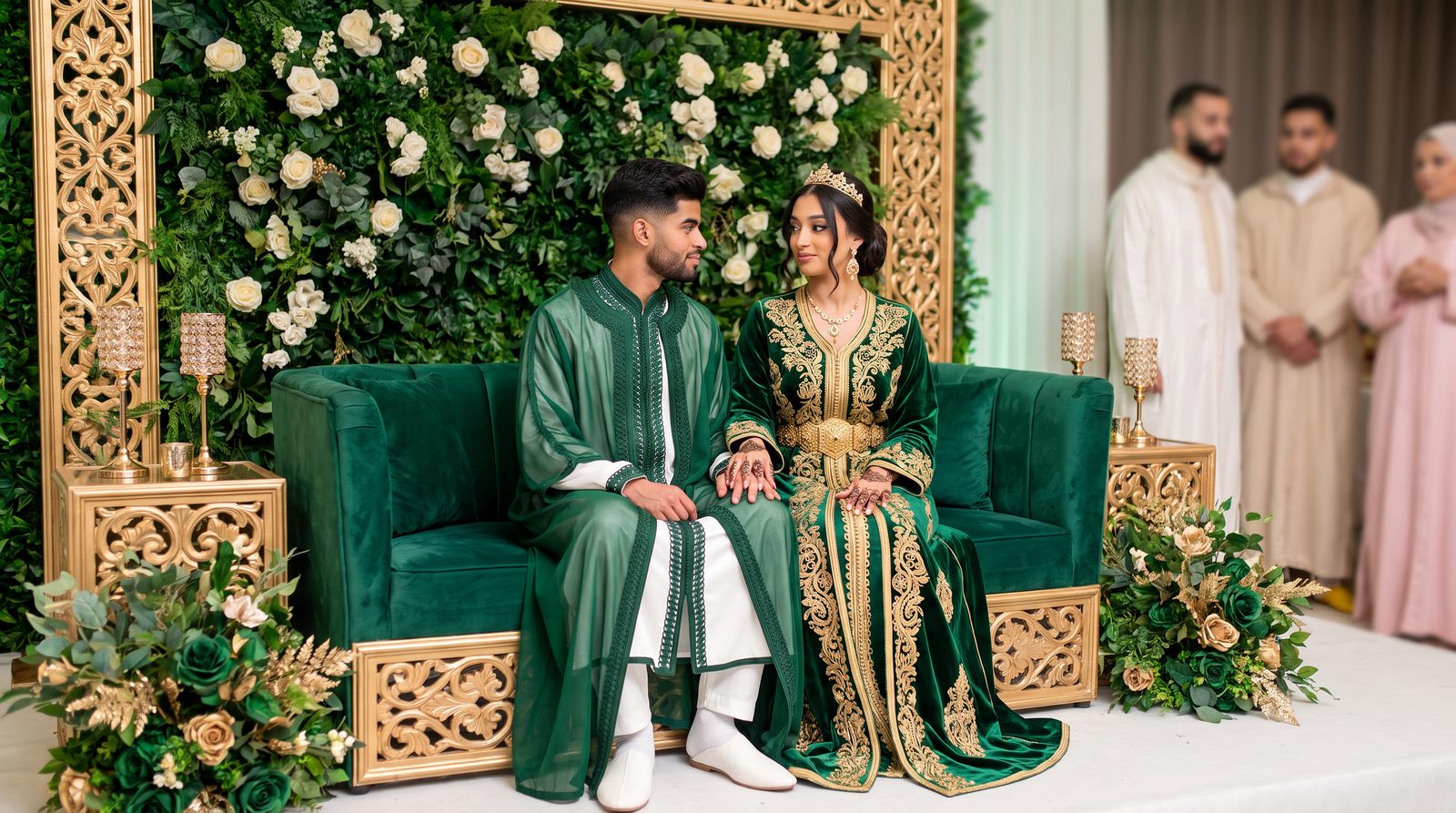
In Morocco, the henna night is usually held the evening before the wedding. Green is its color, reserved for the bride and groom. The groom wears a green jabador, kaftan, tunic or djellaba, while guests wear a djellaba, a Moroccan Thobe or smart everyday clothes. We explain how the evening unfolds, the regional traditions and what to wear depending on your role.
The tradition
What is the henna night?
The henna night, or hanna, is the celebration that comes before the wedding. The bride has henna designs applied to her hands and feet, surrounded by the women of both families. In Morocco, it usually takes place the evening before the wedding, sometimes a week earlier, at the bride's parents' home or in a venue.
It is not a religious rite but a festive tradition, shared in Morocco and throughout North Africa. It celebrates the bride, wishes her happiness in her new life, and the henna marks her passage from fiancée to wife.
In France, Belgium or the Netherlands, it is a tradition that is not fading. The evening is often held in a banquet hall, with a more modern atmosphere but the same codes. It is also one of the rare evenings when young men who never wear traditional clothing bring out the djellaba or the jabador and wear it with pride.
How it unfolds
How does a henna night unfold?
The bride gets ready at the hammam, then the neggafa dresses her in green and seats her. Large decorated candles surround the henna tray, the nekacha, also called the hennaya, applies the henna, and then the female guests receive theirs. The evening ends with music, often with the arrival of the groom and his family.
Every family has its own habits, but the thread stays the same from one city to the next. Here is the most common sequence, so you know when the men come into the picture.
The bride's hammam
The bride gets ready at the hammam with her loved ones. This is the start of the festivities, among women.
Taking her place
The neggafa, the wedding specialist, dresses the bride in green and seats her in her place of honor.
The henna tray
Large decorative candles, often decorated with henna themselves, surround the henna tray.
Applying the henna
The nekacha draws the designs on the bride's hands and feet, to the youyous of the female guests.
Henna for everyone
The female guests have a little henna applied to a finger or the palm, as a keepsake of the evening.
The groom's arrival
Depending on the family, the groom arrives with his loved ones to join the bride, pose for photos and dance.
The groom
Does the groom take part in the henna night?
Yes, usually at the end of the evening. The celebration remains mostly female, then the groom arrives with his family to join the bride. Some families hold a joint evening in the same venue, while others organize a men's evening at the groom's parents' home, as in the Rif.
And what about the groom's henna? It all depends on the region. In many families, a small circle of henna is placed in the hollow of his right hand. In eastern Morocco, in Oujda, it is put on his little finger instead, as we explain in our guide to the Oujda wedding. Other families do without it, out of habit or for religious reasons.
What doesn't change is how the guests look at him. When the groom walks into the room, he is photographed from every angle. His outfit echoes the bride's, and it often sets the tone for all the photos of the evening.
The regions
How does henna differ across the regions of Morocco?
The henna night has the same meaning everywhere in Morocco, but each region has its own way of celebrating it. In the Rif, the groom often has his own henna night at his parents' home. Among the Berbers of the Souss, it is celebrated with songs and dances. In the Sahara, the bride receives her henna draped in her mlahfa.
In the Rif, the bride receives her henna at her parents' home, while the men of the village gather around the groom at his family's home and sing in groups. Traditionally, the groom wears a new djellaba with the hood up and dips his right hand into the henna paste.
Among the Chleuhs of the Souss, the celebration sometimes lasts several days, and the bride's henna is applied to the sound of tangguift songs, before the ahwach dances. We cover it all in our guide to the Shilha wedding. In the Sahara, the m'aalma applies henna and kohl to the bride, adorned in gold, while the men wear the daraa, as we explain in our guide to the Sahrawi wedding.


The groom's outfit
What should the groom wear for the henna night?
For the henna night, the groom wears a green outfit, echoing the bride's green kaftan or takchita. The three-piece green jabador is the great classic, the green and gold kaftan adds more radiance, and the green djellaba remains the most traditional. The velvet tunic, more modern, appeals to younger grooms.
Visit Jabador Green Hanna was designed for that very evening. A green chiffon cape is worn open over a white jabador embroidered in green and white trousers. White brightens the face, while the sheer green echoes the bride without overpowering her. For a stronger presence, the Kaftan Green and Gold pairs the same green chiffon with gold embroidery.
The Green Djellaba with its hood, double sfifa and hand embroidery, remains the choice of grooms attached to tradition. The Green Velvet Tunic, for its part, is less traditional, younger and more modern. Many couples coordinate their shades, green and white for him if she wears a deep green, gold touches if her kaftan is embroidered in gold. For a summer evening, the Green Transparent Djellaba in chiffon is lighter.
The groom's green
Jabador, kaftan, djellaba and tunic


The guests
What should you wear to a henna night as a guest?
As a guest at a henna night, a man has three options. A djellaba for fathers and uncles, a Moroccan Thobe for younger men, or smart everyday clothes, a shirt and dress trousers. In every case, choose light shades and leave green to the bride and groom.
Your place in the family matters more than fashion. The father represents his family, so his outfit should say it is a big night without stealing the spotlight from the couple. Younger men have more freedom, and wearing regular clothes is perfectly acceptable, as long as you stay in the festive spirit.
| Your role | The outfit | Colors | Why |
|---|---|---|---|
| The groom | Jabador, kaftan, djellaba or tunic | Green and white, green and gold | Echoes the bride's green outfit |
| The father, the uncles | Djellaba | White, beige, gray | Dressy and understated, it represents the family |
| Younger men | Moroccan Thobe | White, beige, sky blue | Light, easy to dance in all evening |
| Regular clothes | Shirt and dress trousers | Light or neutral | Simple, always well received |
For fathers, a white or beige djellaba man strikes just the right note. For younger men, a light-colored Men's Moroccan Thobe , plain or embroidered, is enough to look well dressed without overshadowing the couple. Black is best avoided, as it is not a color for a celebration.
The color
Why is green worn at the henna night?
Green is worn at the henna night because it is the color of the henna plant and its paste. The bride wears a green kaftan or takchita, the groom joins her in green, and the guests leave this color to them so they stand out in the photos.
For the groom, every shade works, but they don't all say the same thing. Emerald green is the most festive. Deeper fir green suits thick fabrics like velvet or gabardine. Green and white stays fresh and easy to wear. Depending on the region, the bride may also wear royal blue, garnet or white, since she often changes outfits during the evening.
Getting ready
When should you order your henna night outfit?
Order your outfit three to four weeks before the henna night. You will have time to try it on, exchange it if the size is not right and have it pressed. At Jabador.com, delivery takes 24 hours to 3 days in France and 2 to 4 days within the European Union.
The henna date is often known one or two months in advance, but it is also a time when you are running around between the venue, the caterer and the invitations. It is better to sort out your outfit early. Returns are accepted within 14 days, and shipping is free on orders over €80.
The day before, lay everything out. The outfit pressed, the babouches clean, and for the groom, a second outfit if the family plans a change during the evening. Every Jabador.com piece is made in our workshops in Morocco, in Fès and Casablanca.
The right outfit at the right time
On the henna night, green dresses the bride and groom and the whole family gathers around them. Choose an outfit that suits you and wear it with pride, wherever you celebrate.
Discover our men's jabadorsYou wonder
Frequently asked people ask
Is the henna night always held the evening before the wedding?
In Morocco, most of the time, yes. The henna night is traditionally held the evening before the wedding, at the bride's parents' home. Some families hold it up to a week earlier, especially when the celebration takes place in a venue.
Does the groom wear henna?
It depends on the family and the region. Many place a small circle of henna in the groom's right palm. In eastern Morocco, in Oujda, it is put on the little finger instead. Other families skip it.
What color should you wear to a henna night as a guest?
Light shades such as white, beige, pearl gray or sky blue. Green is the color of the bride and groom, so leave it to them. Black is best avoided, as it has no place at a celebration.
Can you wear regular clothes to a henna night?
Yes. Fathers often wear the djellaba and young men the Moroccan Thobe, but a dress shirt and smart trousers in light shades are perfectly acceptable for a guest.
What is the difference between the neggafa and the nekacha?
The neggafa dresses the bride, seats her and orchestrates her outfit changes. The nekacha, also called the hennaya, is the woman who draws the henna designs on the hands and feet.
How far in advance should you order your henna night outfit?
Three to four weeks before the evening, so you have time to try it on and exchange it if needed. Jabador.com delivers in 24 hours to 3 days in France and accepts returns within 14 days.