
The Moroccan wedding caterer does much more than the meal. They serve the menu, pastries, starter, pastilla or chicken, meat, fruit and wedding cake, but often also bring the venue decoration, the tables, the tableware and the service. Together you set the number of tables and guests, then a price per menu. This guide details the menu and its codes, the decoration, venue packages, prices in Morocco and in Europe, and tips for a small budget.
Much more than a meal
The caterer, a pillar of the evening
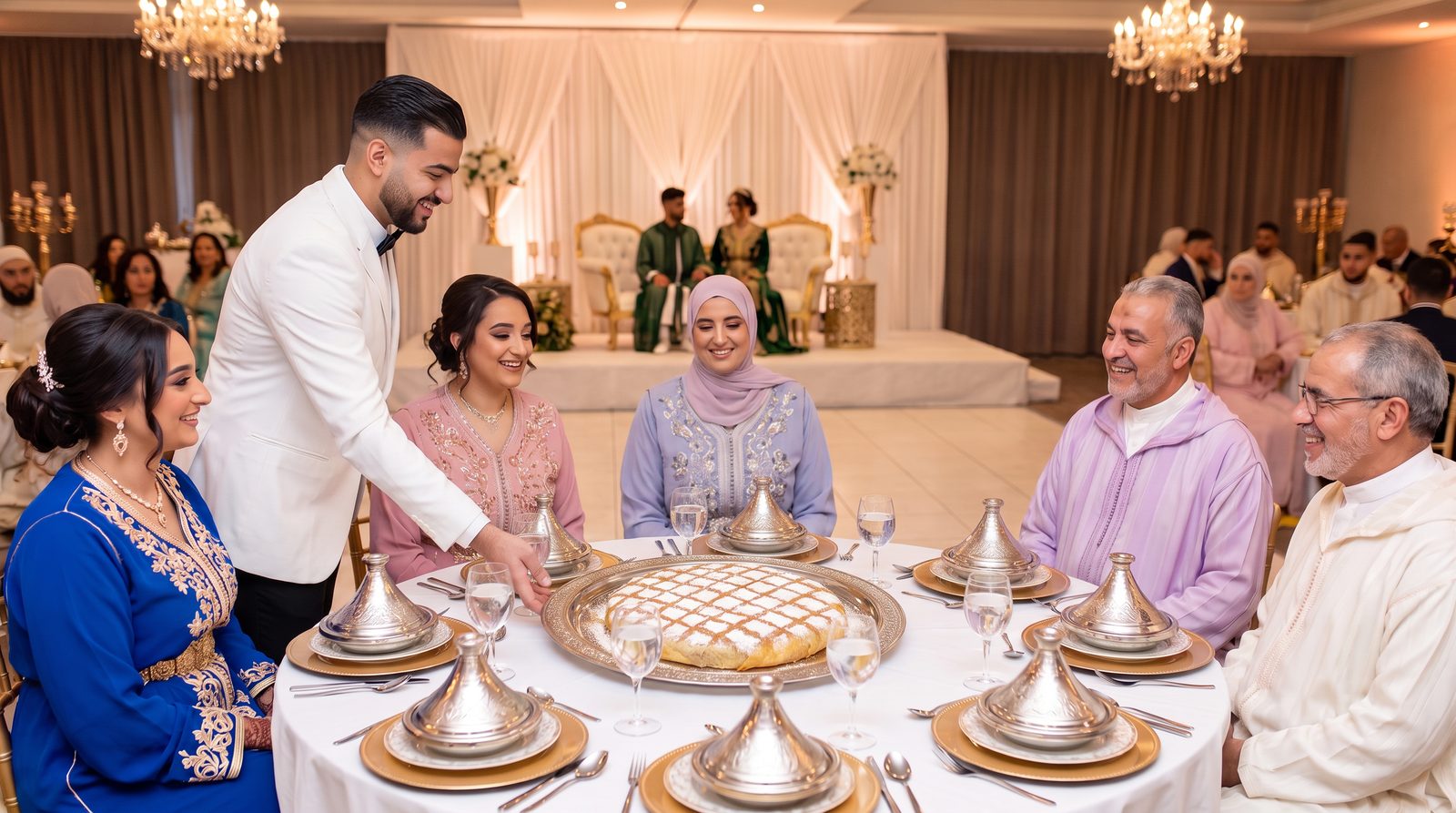
A Moroccan wedding caterer prepares and serves the wedding meal according to the codes of Moroccan cuisine, but their role goes well beyond the plate. They often bring the venue decoration, the tables, the tablecloths, the table decorations, the cutlery and the plates, as well as the waiters, and provide table service in which each dish is shared from the center.
This service is what sets them apart from a standard caterer. No plates arranged in the kitchen, but one large dish per table of eight to ten people, brought out in procession by the waiters. Dinner often arrives late, after the couple's entrance and the bride's first outfits.
The caterer works hand in hand with the negafa, who dresses the bride and orchestrates her appearances, and with the DJ or the band. Together, the three set the rhythm of the evening.
The menu
What is served at a Moroccan wedding?
The menu at a Moroccan wedding almost always follows the same order. Pastries on arrival, a starter, either a large mixed salad or a small pastilla for each guest, then two main courses. The first is a whole pastilla or chicken with olives, and the second is always meat. The fruit platter and the wedding cake end the meal.
Every caterer has their own recipes, but the sequence stays the same from one wedding to the next. Here is a typical evening, from the guests' arrival to dessert.
The pastries
Moroccan pastries, gazelle horns, ghriba and honey briouats, served with drinks while the room fills up.
Salad or small pastillas
Most often a large mixed salad in the center of the table. Otherwise, small pastillas, one for each guest.
Pastilla or chicken
After a salad, the whole pastilla, with chicken or fish, arrives on a large platter. If the starter was already a small pastilla, it is time for chicken with olives and preserved lemon.
The meat
Whatever the menu, the last course is meat, with prunes and almonds, or lham bkhar.
Fruit and wedding cake
A large fruit platter, then the wedding cake, cut by the couple.
The codes
What are the must-have dishes, and their codes?
The Moroccan wedding menu is built on two formulas. With a mixed salad as a starter, the whole chicken or fish pastilla comes as course 1. With small pastillas as a starter, course 1 becomes chicken with olives. In both cases, course 2 is meat, with prunes and almonds or as lham bkhar.
These rules are not written down anywhere, but every family knows them, and a good caterer suggests them automatically. The table sums up the dishes and how they are served.
| Dish | What it is | The code to know |
|---|---|---|
| Mixed salad | Large platter of assorted salads in the center of the table | The most common starter, with the whole pastilla following as course 1 |
| Small pastillas | One small individual pastilla per guest | Served as a starter, course 1 switches to chicken with olives |
| Whole pastilla | Thin flaky pastry served whole, with chicken and almonds or with fish | Course 1 when the starter was a salad |
| Chicken with olives | Chicken with olives and preserved lemon, served whole | Course 1 when the starter was already a pastilla |
| Meat with prunes | Tender meat with prunes and toasted almonds | Course 2, the great classic |
| Lham bkhar | Half a lamb steamed, then browned in the oven with small vegetables | The prestige course 2, in place of meat with prunes |
| Fruit platter | Seasonal fruit arranged in a pyramid | Always before the wedding cake |
| Wedding cake | Tiered cake cut by the couple | Borrowed from European traditions, now found everywhere |
The price
How is a wedding caterer's price calculated?
With a Moroccan caterer, you first agree on the number of guests per table and the number of tables, then on a price for the chosen menu, pastries, starter, course 1, course 2 and dessert. The quote is therefore often per table rather than per person, with options for decoration, service or the wedding cake.
A table of ten is the most common basis. Changing a dish, switching from meat with prunes to lham bkhar or from chicken pastilla to fish pastilla, changes the price. Always ask for a quote itemized line by line so you can compare two caterers on the same menu.
The decoration
Who handles the wedding decoration?
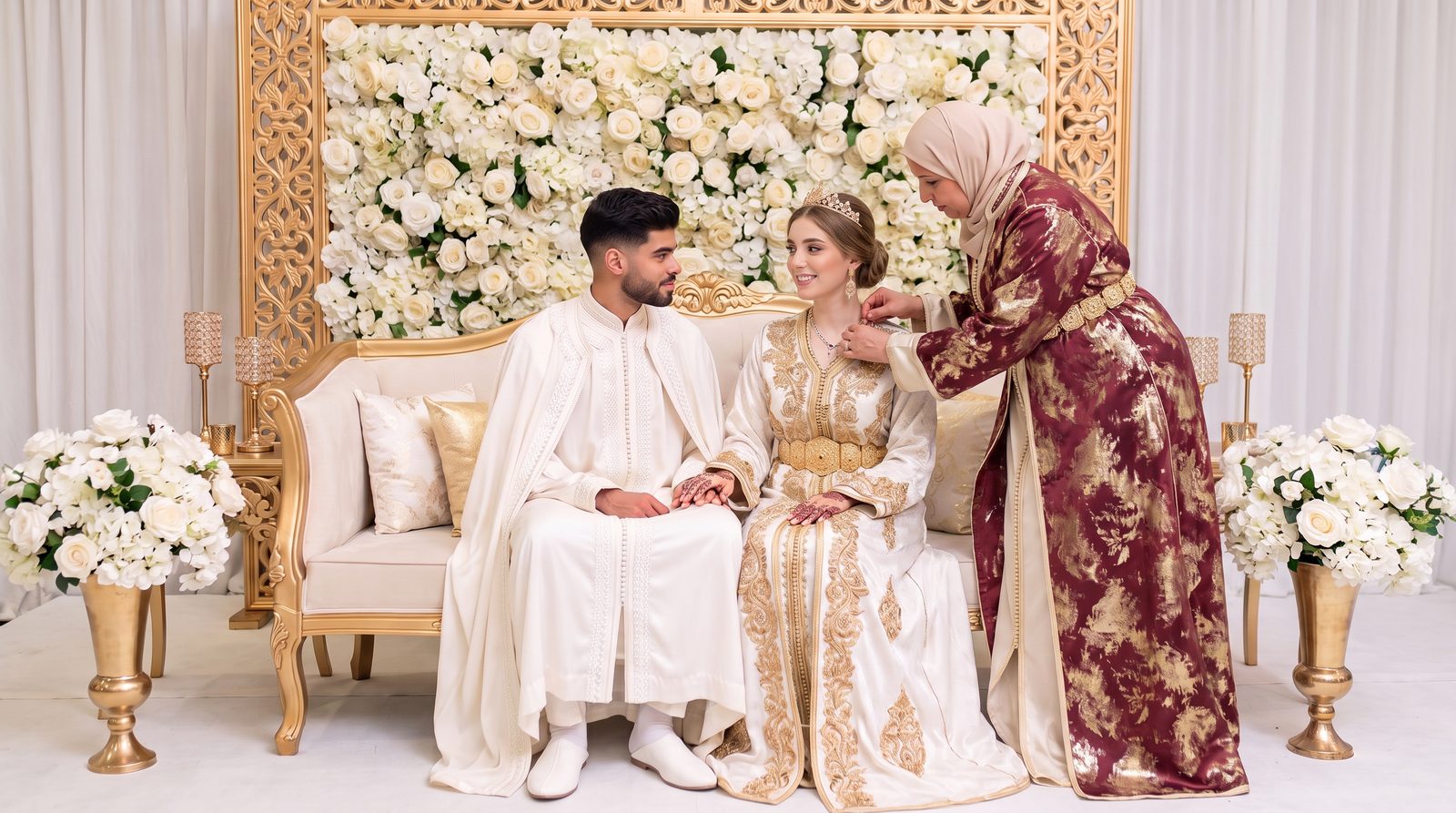
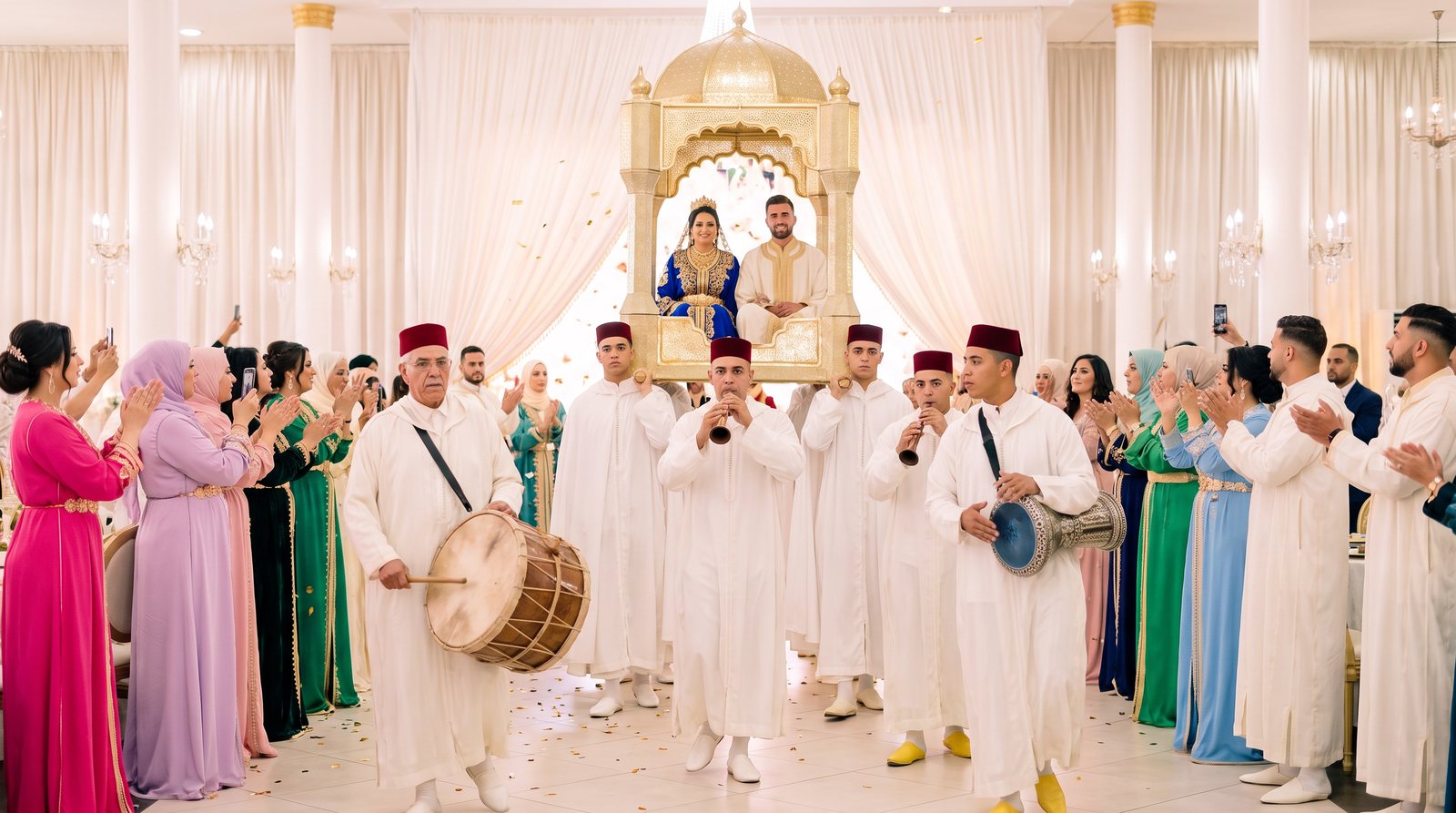
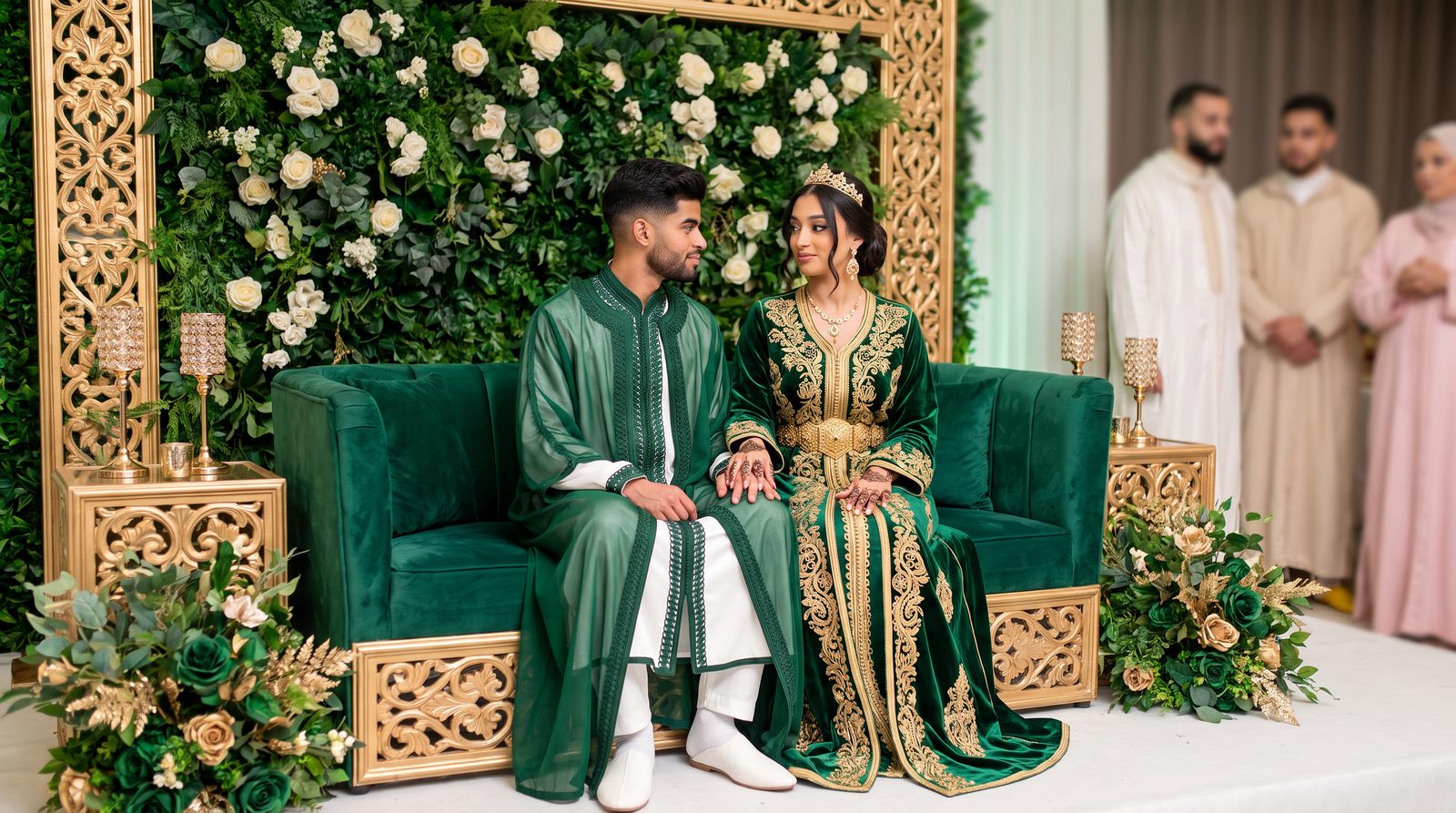
At a Moroccan wedding, the decoration is shared. The caterer often brings the venue decoration, the tables, the tablecloths, the centerpieces, the cutlery and the plates. The negafa brings the gelsa, the seating area where the couple sits, and the amariya, the palanquin for their entrance.
The gelsa is the heart of the photos. Sofa or thrones, floral backdrop, gilded frames, it often changes color along with the bride's outfits. The amariya, for its part, arrives with its bearers for the couple's entrance.
Some families also hire a separate decorator for a particular atmosphere. In that case, make sure it is clear who provides what, so you don't pay twice for the same tables or tablecloths.
The venues
Fully equipped venue or separate vendors?
More and more Moroccan weddings take place in fully equipped wedding venues that offer a package with every service, catering, decoration, negafa, DJ, photo and video, sometimes even the band. Families have a single contact and a single quote, at the cost of a little less freedom on each item.
The package simplifies everything, especially when the family lives far away or does not have time to coordinate five vendors. Separate vendors let you choose your favorite negafa or caterer. Either way, ask to see the venue set up for a real wedding, not just in photos.
The music
DJ or band for a Moroccan wedding?
The trend is leaning more and more toward the DJ, in Europe as in Morocco. A DJ costs less, suits every age group and moves from chaâbi to raï, Andalusian music and current hits. A band, on the other hand, brings real prestige and remains very popular with families for the big moments.
Many couples combine the two, a band or a troupe for the entrance on the amariya and the highlights, then a DJ for the rest of the night. The music always follows the bride's appearances, which the negafa announces. Our guide to Moroccan wedding music details each region's troupes and their prices.
Small budget
How do you organize a Moroccan wedding on a small budget?
On a small budget, the bare minimum is still the negafa and the DJ. You get the decoration separately, and for the meal, you call on tayabate, those mothers known for cooking for big events. It saves money, but it is done less and less, because the mothers of the bride and groom often end up stuck in the kitchen.
Today, many families prefer to pay a caterer so the parents can enjoy the celebration. In between, some tayabate now work as a small team, with service and tableware, at gentler prices than a large caterer. Reducing the number of tables remains the most effective way to cut the budget.
In Morocco
Who are the best-known wedding caterers in Morocco?
The best-known wedding caterer in Morocco is Rahal, founded in Casablanca in 1946, which has long handled major official receptions. Other houses often mentioned in the press include Himmi in Rabat, Dada Gourmande, Amande et Miel and Grand Chemin in Casablanca, Maymana in Rabat and Afrah in Fès.
Rahal started out as a pastry shop in the old medina of Casablanca, opened by Rahal Essoulami, before growing into a group of some twenty companies. Himmi claims more than forty years of expertise in Rabat, and Dada Gourmande more than twenty-five years of weddings.
These big houses are booked very early for summer, the high wedding season, when diaspora families return home.
The budget in Morocco
How much does a wedding caterer cost in Morocco?
In Morocco, a wedding caterer costs around 300 dirhams per person for a decent service, or about 3,000 dirhams for a table of ten, and up to 1,000 dirhams per person or more for high-end catering. In Marrakech, prices gathered in 2026 range from about 500 to more than 1,700 dirhams per person.
The rise in meat prices since 2024 is pushing many families toward smaller weddings. Always check what is included, as service, tableware and hours after midnight are often billed separately.
| Range | Price per person | What is often included |
|---|---|---|
| Standard | 300 to 590 DH | Traditional menu, fruit, pastries |
| Premium | 1,000 to 1,300 DH | Cold starters, two hot courses, dessert buffet, attentive service |
| Luxury | 1,400 to 1,700 DH and up | Signature menu, on-site chef, elaborate plating |
| Often extra | 250 to 400 DH per waiter | Tableware, hours after midnight, corkage fee |
In France
How do you find a Moroccan caterer for your wedding in France?
In France, Moroccan caterers are based near the large communities, in the Paris region, Lyon, Marseille, Lille or Strasbourg. Their prices usually range from €30 to €150 per guest depending on the menu and the service. Most are halal, and many offer a package with venue, decoration and negafa.
Many negafas offer the full catering service themselves, which means you deal with a single contact for the meal and the bride. In that case, ask who actually does the cooking, and do a tasting before signing.
Belgium and the Netherlands
A Moroccan wedding in Belgium or the Netherlands, what should you expect?
In Belgium and the Netherlands, the Moroccan wedding is a big event, often with 100 to 220 guests, in banquet halls equipped for it. In the Netherlands, catering generally costs €30 to €80 per person, and a wedding with 200 guests comes to €10,000 to €30,000 in total.
Both countries have very large communities of Moroccan origin. In the Netherlands, CBS counted around 173,000 people born in Morocco in 2021 and 242,000 born in the Netherlands with at least one Moroccan parent. In Belgium, more than 268,000 Moroccans have acquired Belgian nationality, including nearly 109,000 in Brussels and as many in Flanders, according to Myria.
That weight explains a very high level of expectation. Venues are designed for staging, with gelsa, lighting and an entrance on the amariya, and caterers compete on presentation. With many families coming from northern Morocco, people there speak of a ziana rather than a negafa. In the big cities, Amsterdam, Rotterdam, The Hague, Antwerp or Brussels, prices are on average 20 to 40% higher.
| Item, Netherlands | Indicative price 2026 | Good to know |
|---|---|---|
| Venue, 120 to 250 people | €1,200 to €2,500 | Excluding deposit, cleaning and extra hours |
| Large venue, 250 to 400 people | €2,500 to €4,500 | Saturday evening, book very early |
| Caterer | €30 to €80 per person | Halal, menu and service to be confirmed |
| Full wedding, 200 guests | €10,000 to €30,000 | Depending on ziana, decoration, photo and music |
In Belgium, Brussels wedding caterers list prices of €85 to €150 per person in 2026 for a served meal, all styles combined. Moroccan caterers are often below that, with packages suited to large guest numbers.
Choosing well
How do you choose your Moroccan wedding caterer?
To choose your Moroccan wedding caterer, book ten to twelve months ahead, insist on a tasting, check the halal certification and get everything in writing, menu, number of tables, waiters, decoration, tableware, schedule and deposit. Plan for at least one waiter per twenty to twenty-five guests for smooth service.
The tasting is often deducted from the bill if you sign. Also ask for the list of allergens, which every caterer in Europe must be able to provide, and what happens if the evening runs past the scheduled time.
Questions to ask before signing. How many guests per table, and how many tables? What exact menu, from starter to dessert? Are the venue decoration, centerpieces, tableware and linens included? How many waiters for my guests? Who provides the wedding cake and the drinks? From what time are extra hours billed? What deposit, and what terms if the wedding is postponed?
The service
How are the waiters dressed at a Moroccan wedding?
Waiters at a Moroccan wedding wear either a jabador, often white, or a suit. When the couple makes their entrance, many put on a selham, the long hooded cape, to carry the bride on the amariya. Their outfit is part of the show and matches the service to the atmosphere of the evening.
The waiters' jabador echoes the outfit also worn by the groom and the guests, which gives the room a harmonious look in the photos. Our guide tothe history of the jabador tells where this garment comes from.
The selham, for its part, is reserved for the amariya bearers. This moment is prepared with the negafa, who seats the bride, and set to the rhythm of the troupe or the band, as explained in our guide to Moroccan wedding music.
Wedding guides
Planning the rest of the wedding
The caterer is only one part of the celebration. Our guides detail the role of the negafa, the music, the henna night and the regional wedding traditions, along with what the groom wears at each stage.
For an overview, start with our guide to the Moroccan wedding. Each city also has its own customs at the table, in Fez, in Rabat, in Marrakech or in theOriental region.

The right outfit at the right time
The caterer treats your guests, and it is up to you to take care of your outfit. Every Jabador.com piece is made in our workshops in Morocco, in Fès and Casablanca.
Discover our men's jabadorsYou wonder
Frequently asked people ask
What is the menu at a Moroccan wedding?
Pastries on arrival, a starter, either a large mixed salad or small pastillas, then two main courses. After a salad, a whole chicken or fish pastilla; after small pastillas, chicken with olives. The second course is always meat, with prunes or as lham bkhar, before the fruit platter and the wedding cake.
What is lham bkhar?
Lham bkhar is half a lamb steamed and then browned in the oven with small vegetables. It is a showpiece of Moroccan weddings, served as the second course in place of meat with prunes.
Does the caterer handle the decoration?
Often, yes. The Moroccan caterer brings the venue decoration, the tables, the centerpieces, the cutlery and the plates. The couple's gelsa and the amariya are generally provided by the negafa.
How much does a Moroccan caterer cost per person in France?
Usually €30 to €150 per guest, depending on the menu, the service and the decoration. You generally agree on the number of tables and guests per table, then a price for the chosen menu.
How much does a wedding caterer cost in Morocco?
Around 300 dirhams per person for a decent service, up to 1,000 dirhams or more for high-end catering. In Marrakech, prices gathered in 2026 range from about 500 to 1,700 dirhams per person.
What is the best-known caterer in Morocco?
Rahal, founded in Casablanca in 1946, is the best known. Other well-regarded houses are often mentioned, such as Himmi in Rabat, and Dada Gourmande, Amande et Miel and Grand Chemin in Casablanca.
DJ or band for a Moroccan wedding?
The DJ is gaining ground in Europe as in Morocco, since it costs less and suits every guest. A band brings more prestige, and many couples combine the two.
How are the waiters dressed at a Moroccan wedding?
In a jabador, often white, or in a suit. For the couple's entrance, many put on a selham to carry the bride on the amariya.