
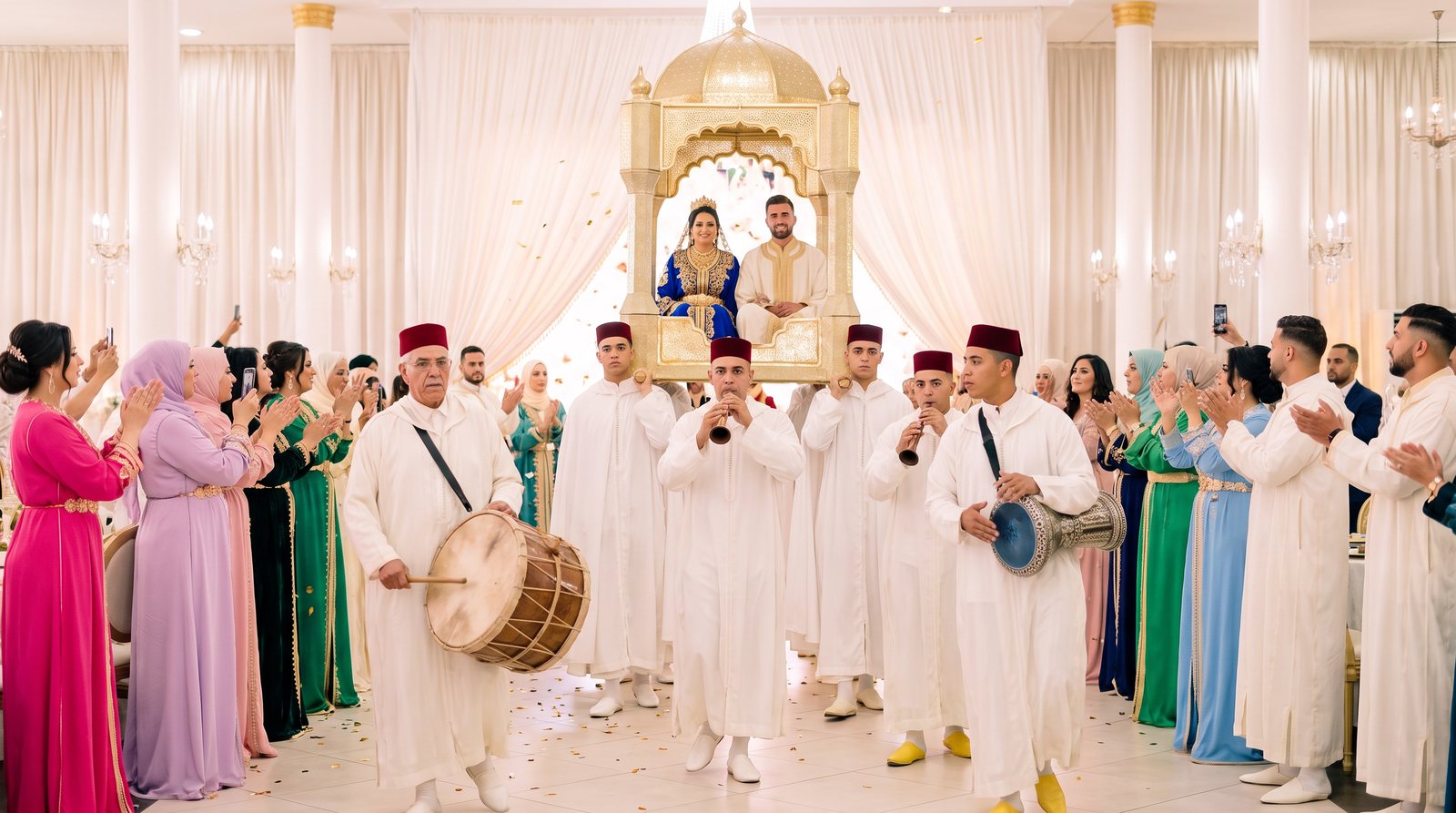
Music sets the rhythm of the entire Moroccan wedding, from the dakka procession to the entrance on the amariya, from the bride's appearances to the dance floor. Each region has its own sounds, the ahidous of the Middle Atlas, the reggada of the Oriental region, the aïta and its violin in the Chaouia, the dakka marrakchia, the tbel and the ghaita of the North. We explain the traditions, the choice between a DJ and a band, and the prices.
The heart of the celebration
Music, the common thread of the Moroccan wedding
At a Moroccan wedding, music is not background noise, it sets the tempo for the whole evening. It accompanies the procession, announces the couple's entrance on the amariya, greets each of the bride's new outfits and keeps the guests dancing until the end of the night. It is played by a traditional troupe, a band, a DJ, or all three.
Musicians and the negafa work together. When the negafa prepares an appearance, the band or the DJ starts the matching piece, and the youyous do the rest. The caterer, for their part, time the dinner service around the musical breaks.
Each family also brings the music of its region. A wedding between a bride from Oujda and a groom from Casablanca will happily move from reggada to chaâbi, and a family from the Souss will want to hear ahwach. This blend is what gives a Moroccan wedding in Europe its identity.
The schedule
Which music is played when?
The evening almost always follows the same musical thread. The dakka or the tbel and ghaita open the procession, the band or the troupe accompanies the entrance on the amariya, each of the bride's outfits has its own piece, and then chaâbi and the DJ take over the dance floor until the end of the night.
Here is a typical sequence, to be adapted to the region and the family.
The procession
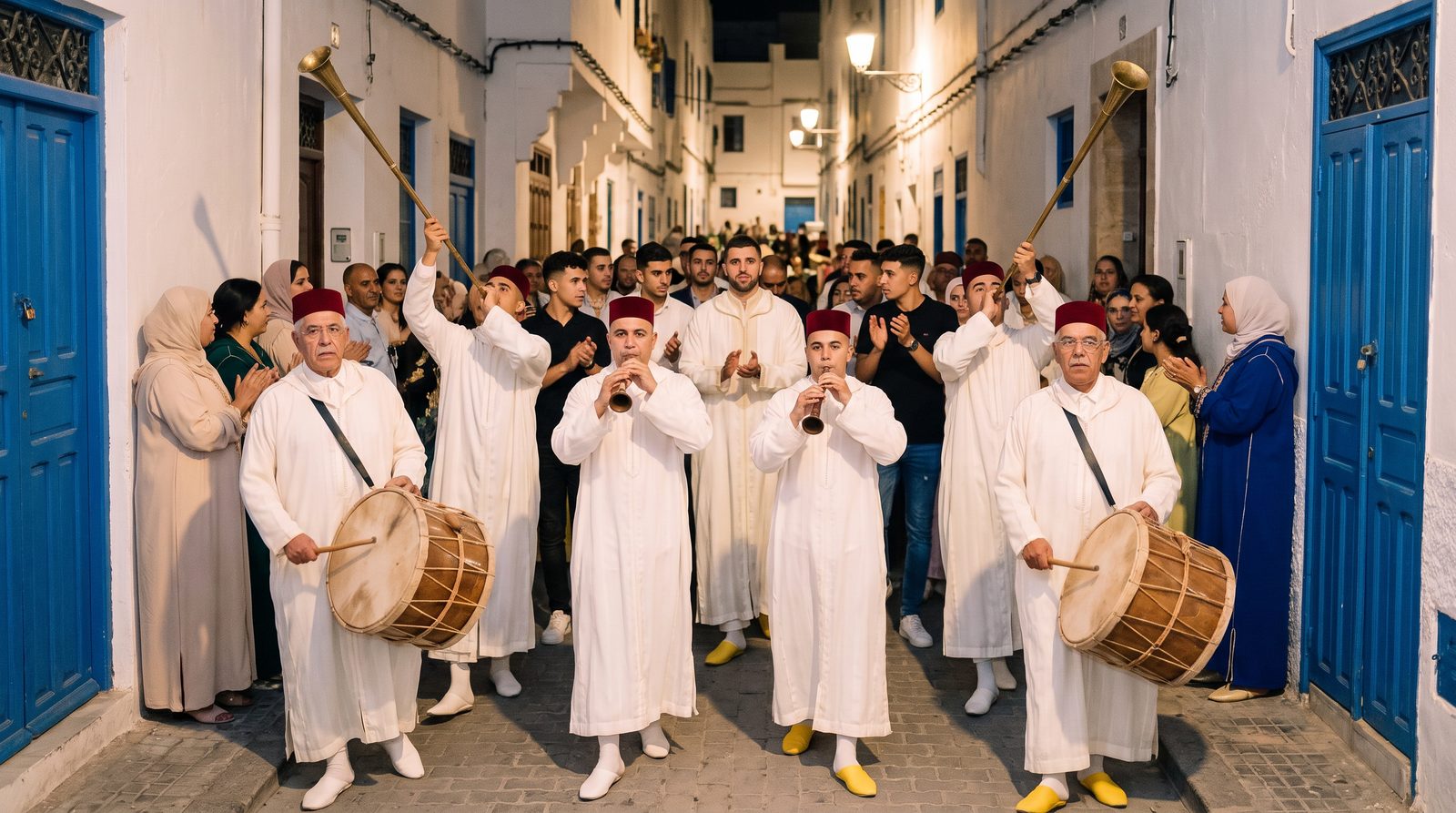
The dakka or the tbel and the ghaita accompany the couple from the house to the venue, sometimes all the way to the town hall.
The praises
In many families, the evening opens with Quran recitation, samaa or songs in praise of the Prophet.
The entrance on the amariya
The couple are carried in to the sound of percussion, youyous and applause.
The appearances
For each new outfit, a chosen piece, often regional, for the fassia, the rbatia or the chamalia.
Softer music
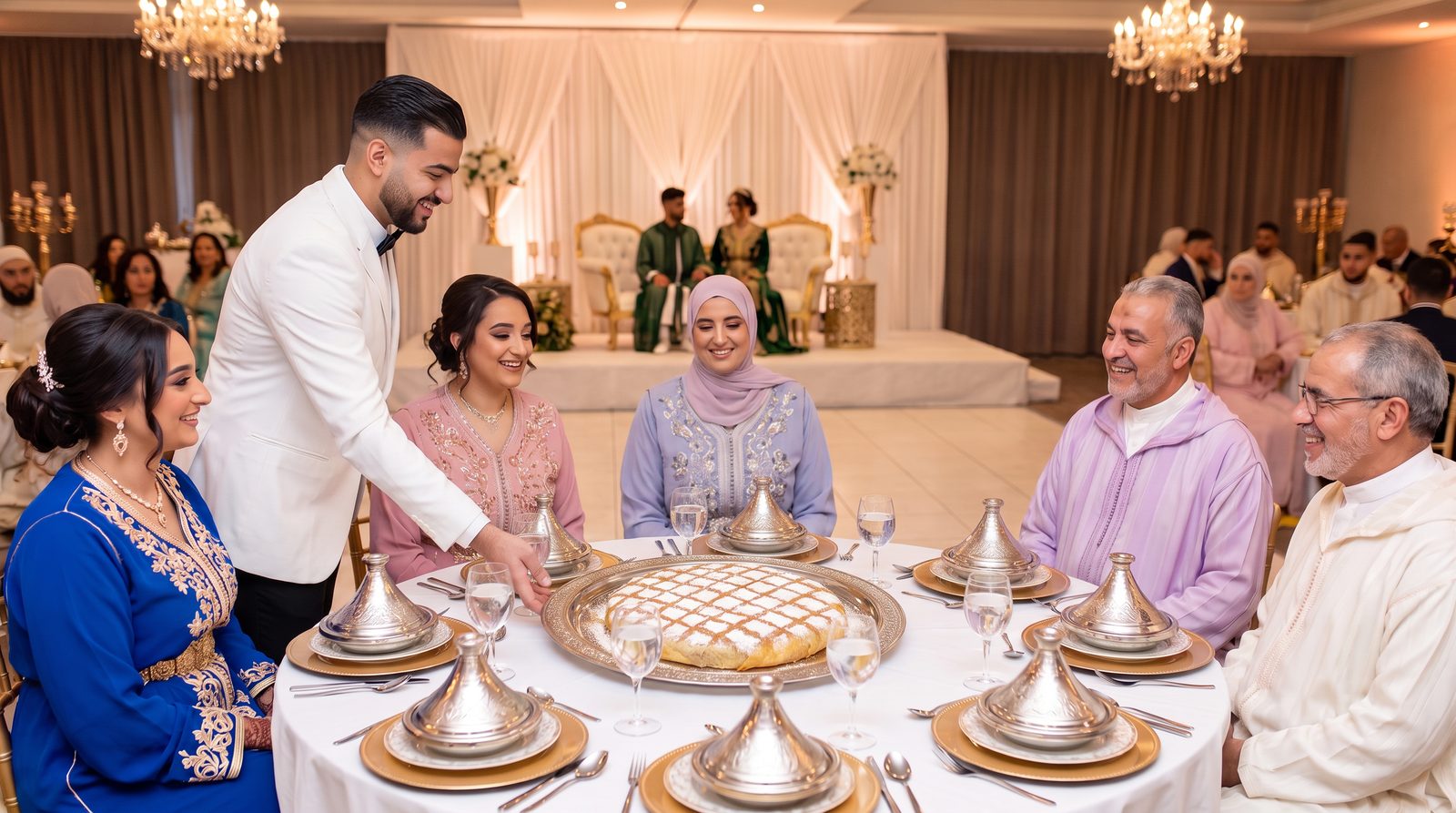
Andalusian music, malhoun or gentle chaâbi while the dishes arrive.
The dance floor
Chaâbi, raï, reggada, ahwach and current hits, often with the DJ.
The choice
DJ or band for a Moroccan wedding?
The DJ is gaining ground, in Europe as in Morocco. A DJ costs less, plays every style and suits every generation. Bands and traditional troupes keep real prestige, especially for the couple's entrance. Many couples combine the two, a troupe for the highlights and a DJ for the rest.
The table sums up the advantages of each option. Most vendors in the diaspora now offer combined packages, with band, dakka and DJ.
| DJ | Band | Traditional troupe | |
|---|---|---|---|
| Atmosphere | Every style, from chaâbi to current hits | Live, singer, violin, darbouka | Show, percussion, costumes |
| Prestige | Medium | High | Very high for the entrance |
| Budget | The most affordable | Higher | Depends on the length |
| Ideal for | The dance floor | Families, big weddings | The procession and the amariya |
The regions
What wedding music is played in each region of Morocco?
Each region has its own wedding music. Ahidous in the Middle Atlas, ahwach and the rways in the Souss, reggada, allaoui and gharnati in the Oriental region, izran in the Rif, aïta and its violin in the Chaouia, dakka marrakchia in Marrakech, Hassani music in the Sahara, and tbel and ghaita in the North.
The table gives the main families. The following cards detail the ones most requested at weddings.
| Region | Music | Instruments |
|---|---|---|
| Middle Atlas | Ahidous | Bendir, hand clapping, singing in rows |
| Souss, High Atlas | Ahwach, rways | Tallunt, naqous, rribab, loutar |
| Oriental region | Reggada, allaoui, gharnati | Bendir, zamar, gasba, later synthesizer |
| Rif | Izran | Bendir, zamar, two-part singing |
| Chaouia, Doukkala, Abda | Aïta, chikhates | Violin, lotar, taarija, bendir |
| Casablanca | Chaâbi bands | Violin, darbouka, keyboard |
| Marrakech | Dakka marrakchia | Taarija, tara, qraqeb, nfar |
| Sahara | Hassani music, guedra | Tbal, tidinit, ardine, guedra |
| North, Jbala | Tbel and ghaita, taqtouqa jabalia | Tbel, ghaita, nfar |
| Fès, Tetouan, Meknes | Andalusian, malhoun | Oud, violin, rebab, darbouka |
Middle Atlas
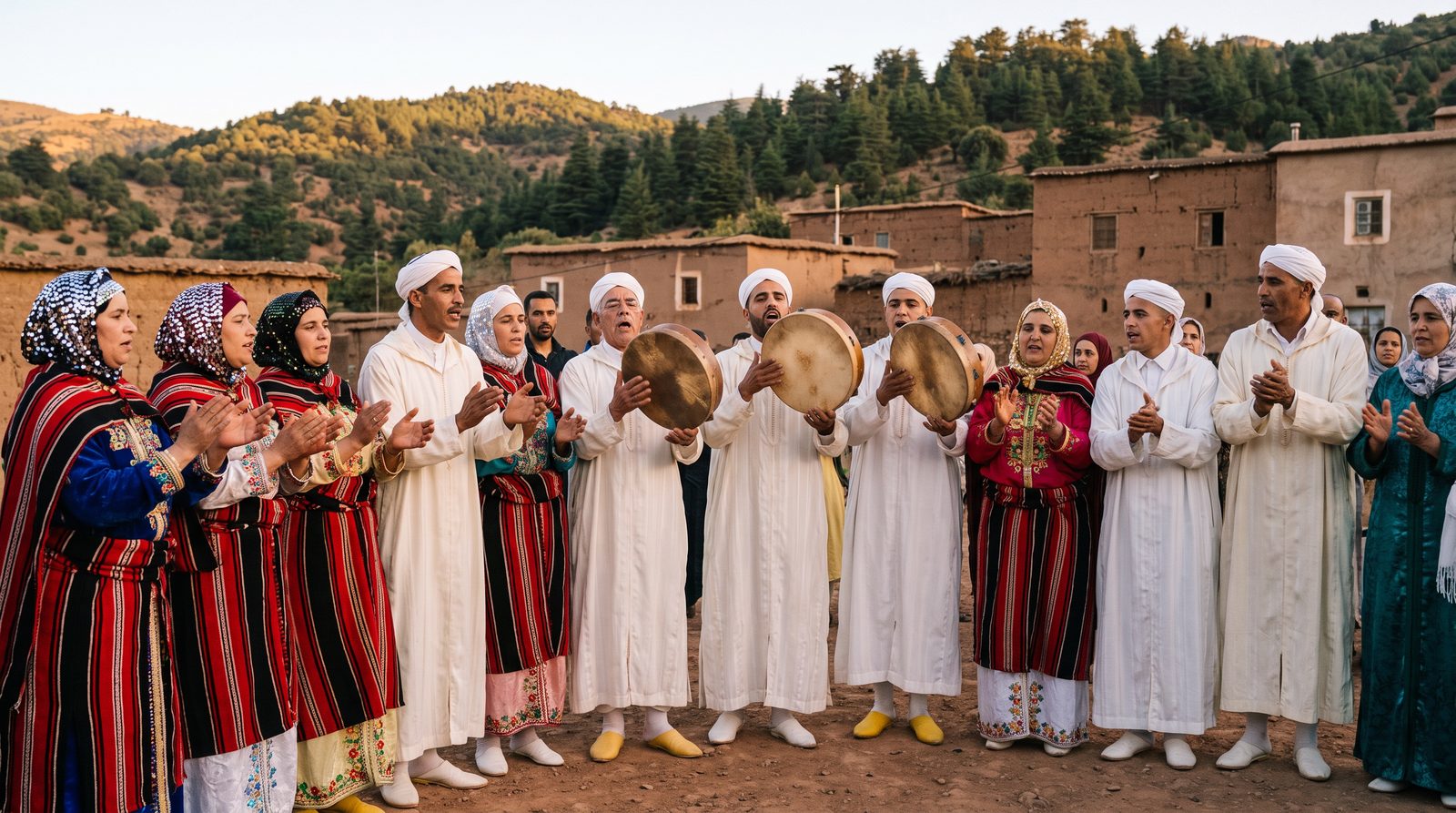
Ahidous, the line dance of the Middle Atlas
Ahidous is the wedding music of the Middle Atlas, in Morocco. Men and women stand in long rows, shoulder to shoulder, and sway together to the sound of the bendir and clapping hands. A singer calls out the verses, the rows answer him, and the dance can last a good part of the night.
Among the Aït Hdiddou, the wedding begins with sung poetic contests between the two families and ends with an ahidous danced in honor of the bride. In Europe, ahidous troupes often come for part of the evening before the DJ takes over.
The instruments
- The bendir, a wooden frame drum covered with a skin, held at face height, which sets the rhythm
- The hands, the clapping of the rows answers the bendir and drives the dance
- The voices, a singer calls out the verses, and the rows of men and women answer him
Souss and High Atlas
Ahwach and the rways, the celebration of the Souss
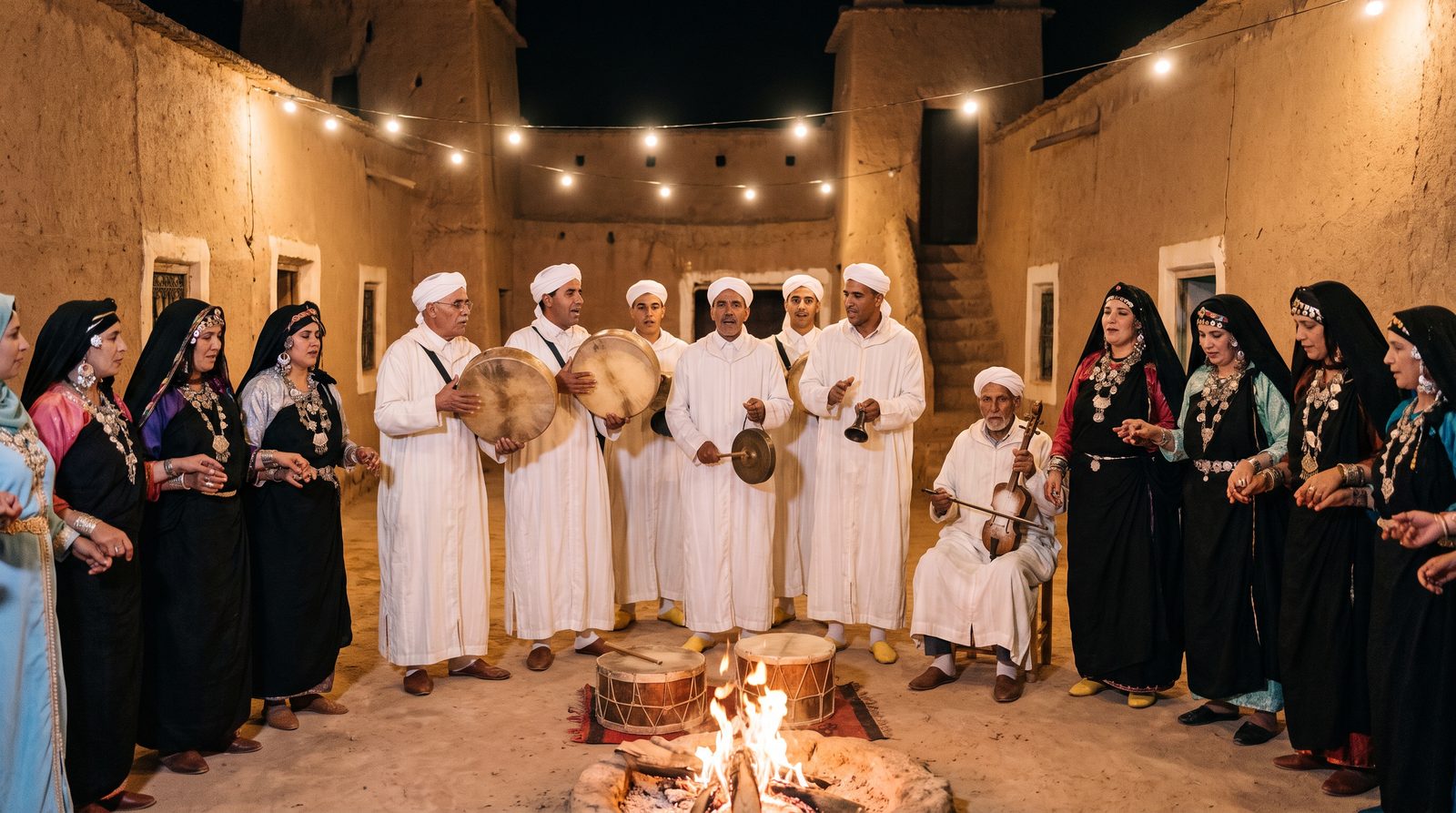
In the Souss and the High Atlas, in Morocco, weddings are celebrated with ahwach. The men play in the center on large frame drums and a metal gong, while the women dance in a circle around them, adorned with silver jewelry. The rways, poet-musicians, add their singing and the rribab.
The rribab is a single-string fiddle, which the raïs often pairs with the loutar. Before playing, the drums are brought close to the fire to tighten their skins. Our guide to the Shilha wedding tells you more about the traditions of the Souss.
The instruments
- The tallunt, a large frame drum, warmed by the fire to tighten its skin
- The naqous, a piece of metal struck with two rods, which keeps the beat
- The rribab, a single-string fiddle, the instrument of the rways
- The loutar, a small lute with three or four strings that accompanies the rribab
The Oriental region
Reggada, the dance of the Oriental region
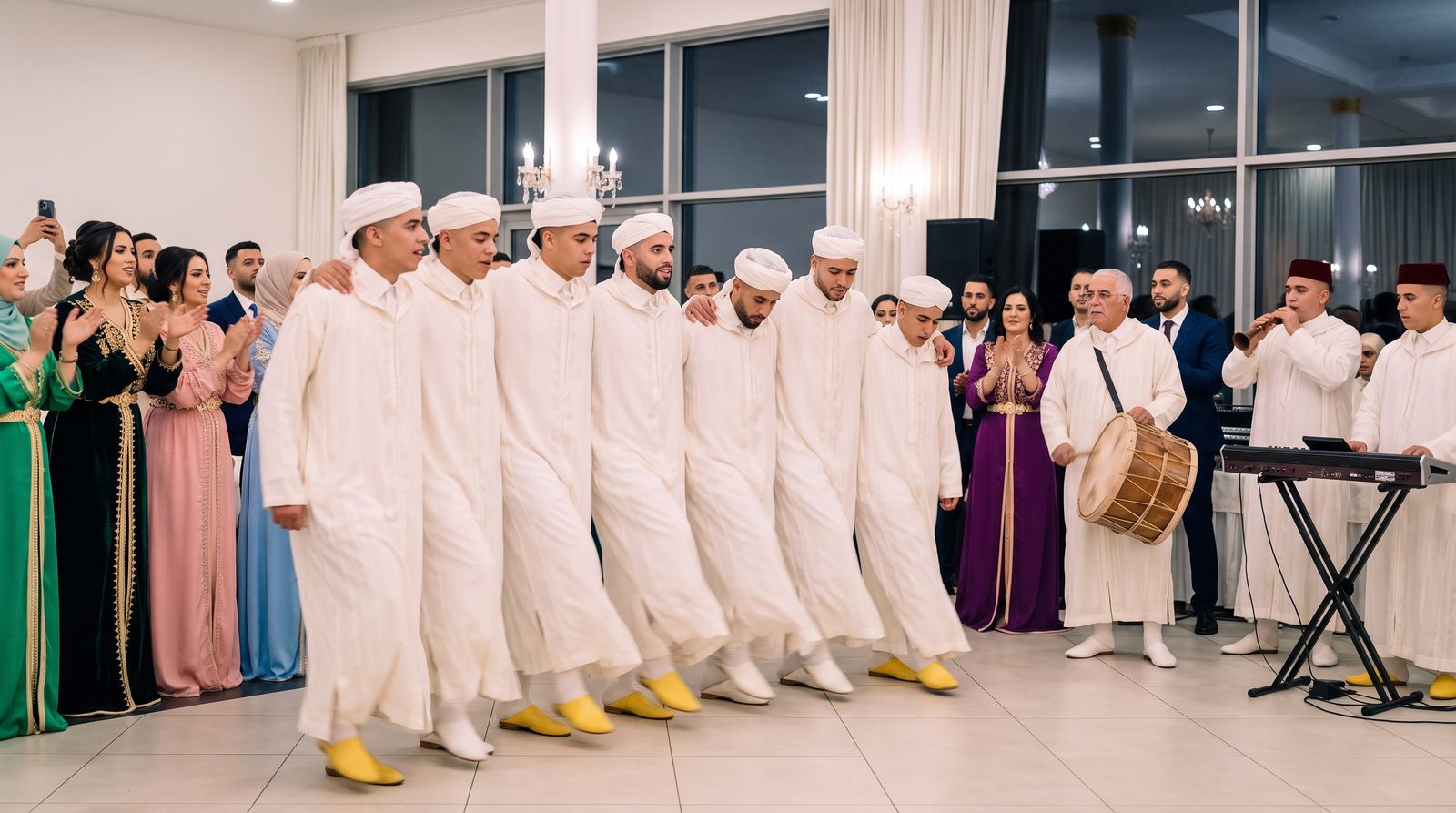
Reggada is the dance of eastern Morocco, from Oujda, Berkane and Nador. It is danced elbow to elbow behind a leader, stamping the ground and rolling the shoulders. Allaoui is closely related, and Oujda also preserves gharnati, an Andalusian music inherited from Granada.
Reggada is played on the bendir, the zamar, a double clarinet ending in two horns, and the gasba, joined by the synthesizer since the late 1980s. It traveled with the diaspora to Belgium, the Netherlands and France, where it gets every table on its feet. Our guide to the Oujda wedding describes how this music sets the rhythm of the evening.
The instruments
- The bendir, a frame drum that leads the reggada
- The zamar, a double clarinet ending in two horns, with a powerful sound
- The gasba, a long reed flute, for the sung passages
- The synthesizer, which joined reggada groups in the late 1980s
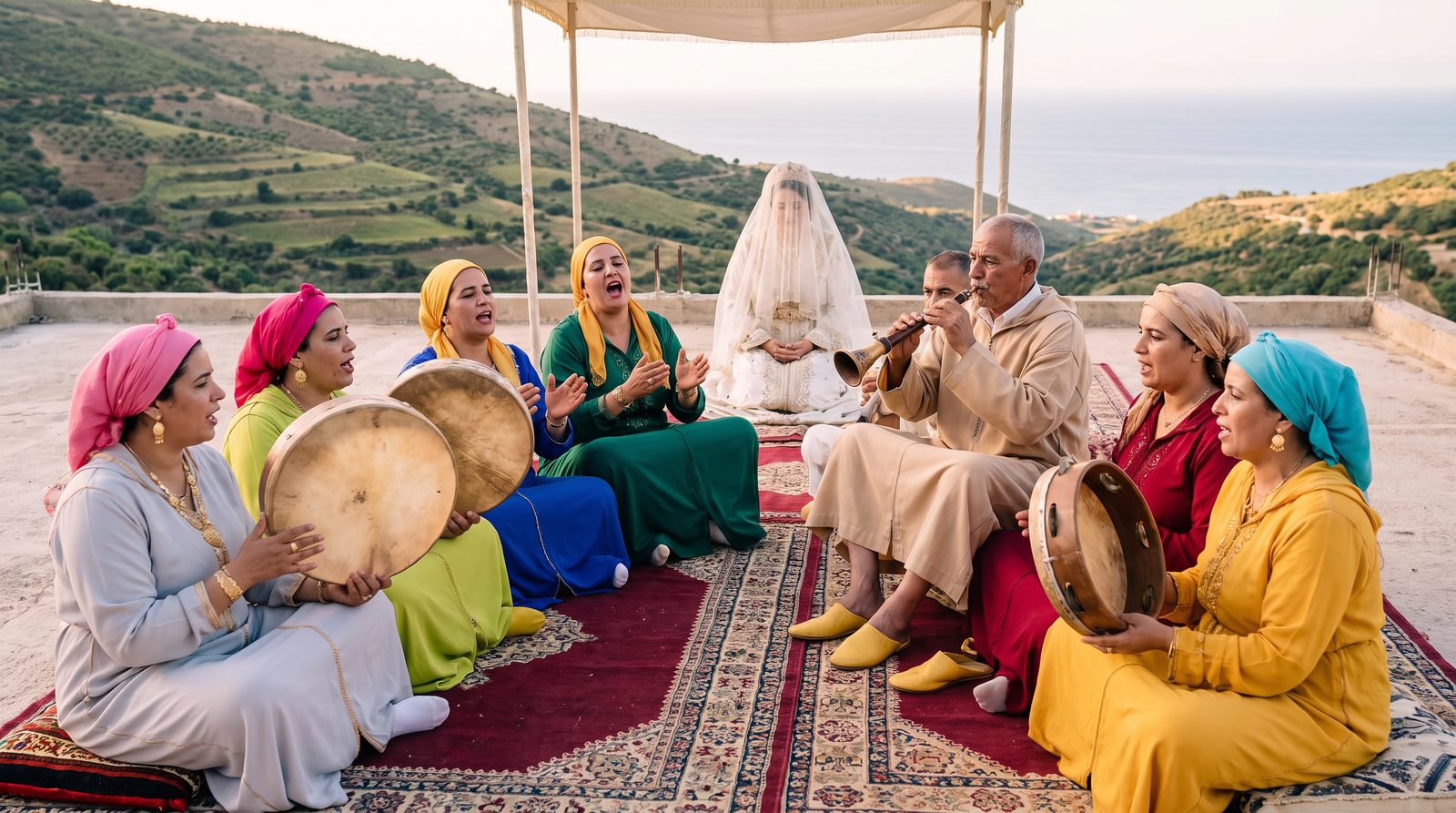
The Rif
Izran, the wedding songs of the Rif
In the Rif, in northern Morocco, the wedding is sung. Izran are short poems in Tarifit, sung by women who answer each other from one group to the next, to the sound of the bendir. The men add the zamar, and the celebration continues with modern Riffian music.
Riffian wedding songs often take up the refrain “ralla bouya,” which the whole Riffian diaspora knows. The Riffian diaspora, large in the Netherlands and Belgium, has kept these songs alive at its weddings, from Amsterdam to Brussels.
The instruments
- The bendir, played by the women who sing the izran
- The zamar, a double clarinet with horns, played by the men
- The voices, the women answer each other from one group to the next
- Oud, guitar and keyboard, in today's Riffian bands
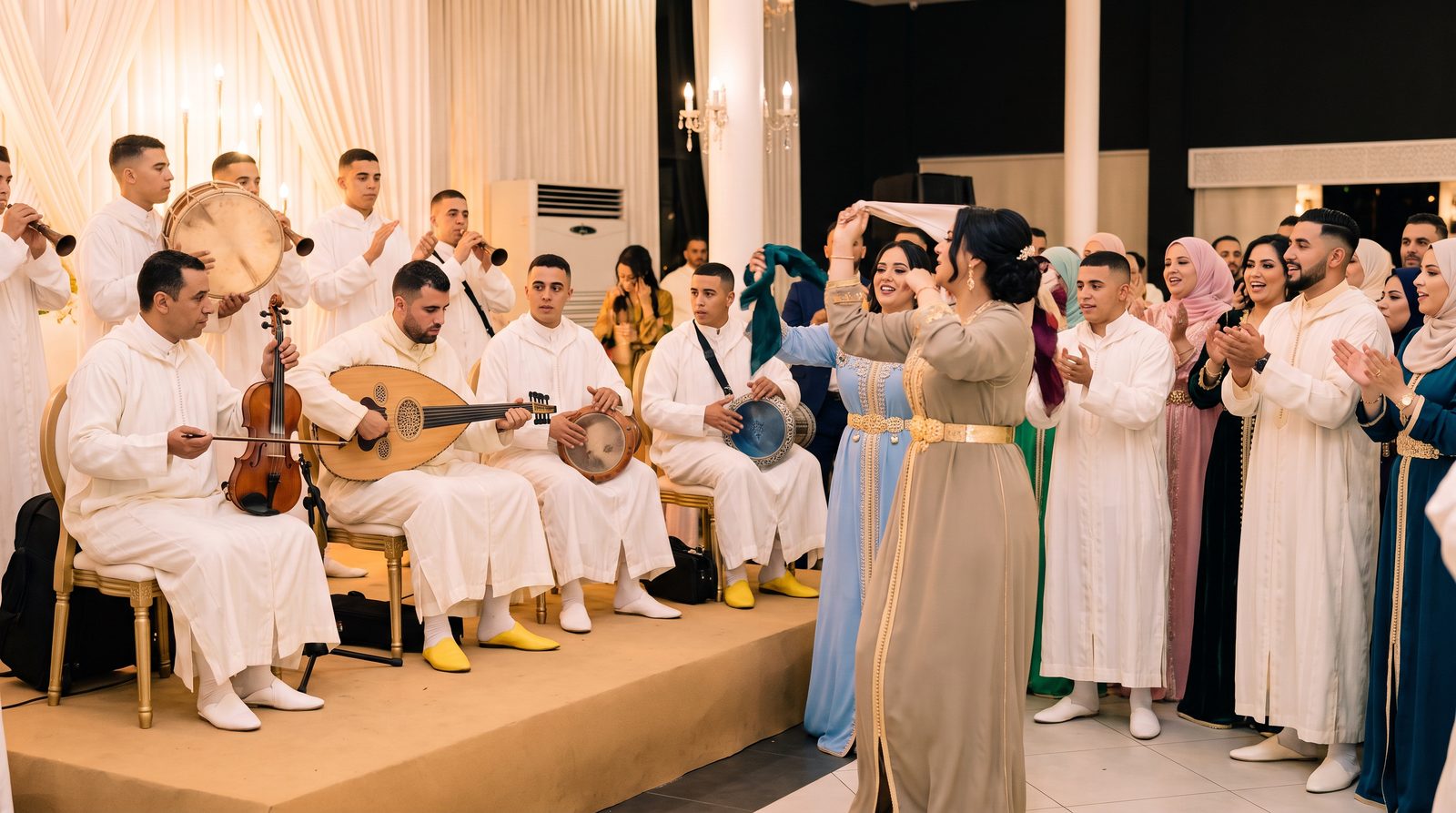
Casablanca and the Chaouia
Aïta and the violin, the soul of the Atlantic plains
Aïta is the song of Morocco's Atlantic plains, the Chaouia, Doukkala and Abda. Carried by the chikhates and their musicians, it is played on violin, lotar, taarija and bendir. In Casablanca, chaâbi bands have kept its violin, which remains the sound of the city's big weddings.
The violin, or kamanja, is played resting upright on the knee and gives Casablanca weddings their unmistakable color. Chaâbi bands then run through the great classics that every generation knows, from Haja Hamdaouia to Najat Aatabou and Abdelaziz Stati.
The instruments
- The kamanja, the violin, played resting upright on the knee
- The lotar, a lute with three or four strings that supports the singing
- The taarija, a small goblet-shaped clay drum
- The bendir, a frame drum that marks the rhythm
- The darbouka, which joins the chaâbi bands of Casablanca
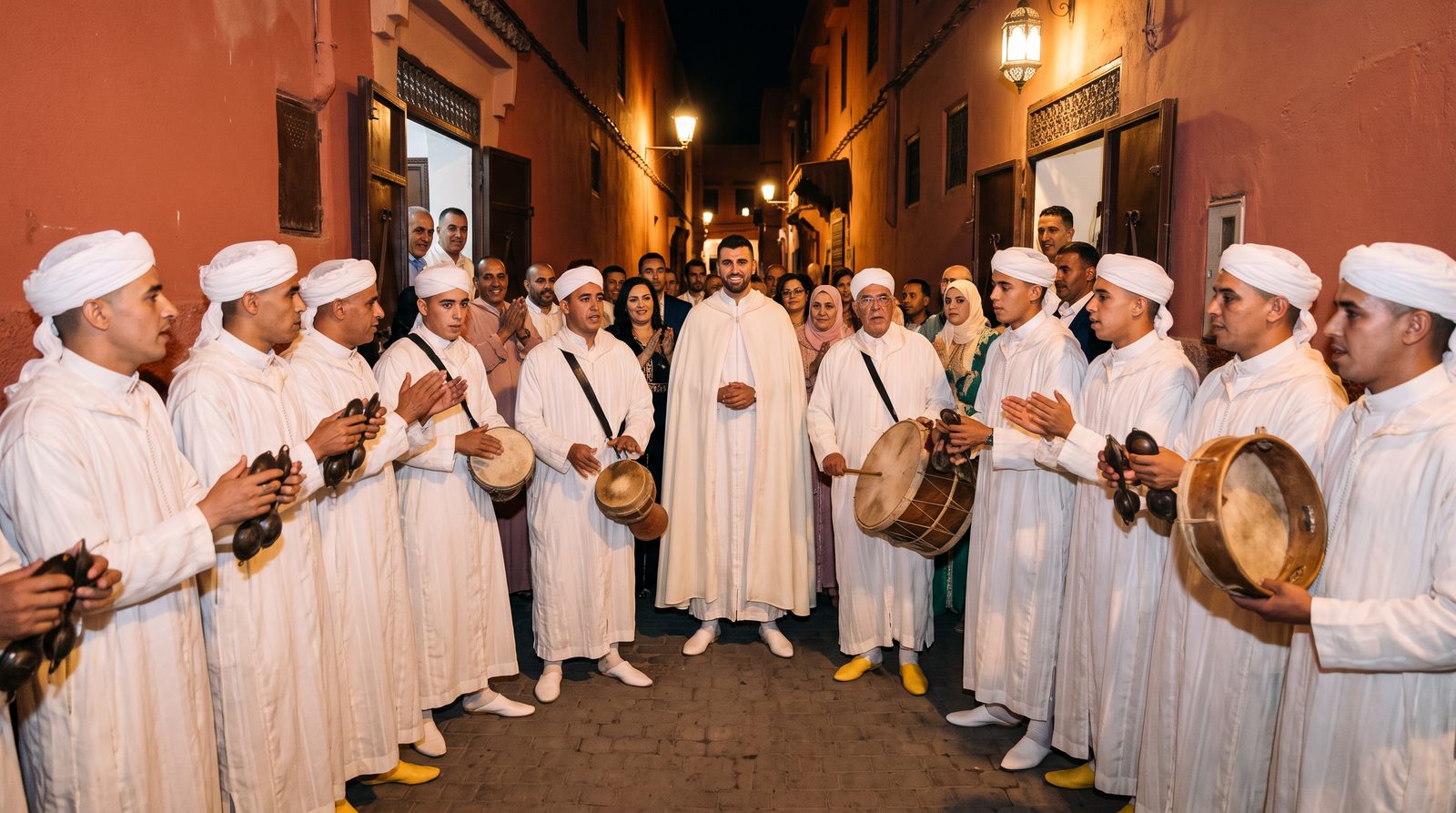
Marrakech
Dakka marrakchia, the procession of Marrakech
In Marrakech, the dakka marrakchia accompanies the couple all the way to the venue. A troupe of men in brightly colored outfits forms a circle and strikes dozens of taarija together, to the sound of the qraqeb, the tara and the nfar. Linked to the Ashura festivities, it has been recognized by ISESCO as intangible heritage of the Islamic world.
Many dakka troupes have settled in Europe, from Lyon to Brussels, and offer the couple's entrance with or without a band. Our guide to the Marrakesh wedding details the rest of the city's traditions.
The instruments
- The taarija, the star instrument of the dakka, a small goblet-shaped clay drum, played in large numbers all at once
- The tara, a large tambourine with jingles, whose player leads the performance
- The qraqeb, large metal castanets that drive the rhythm from the very start
- The nfar, a long brass trumpet that adds power to the most rhythmic passages
- The bendir, a frame drum sometimes added to the troupe
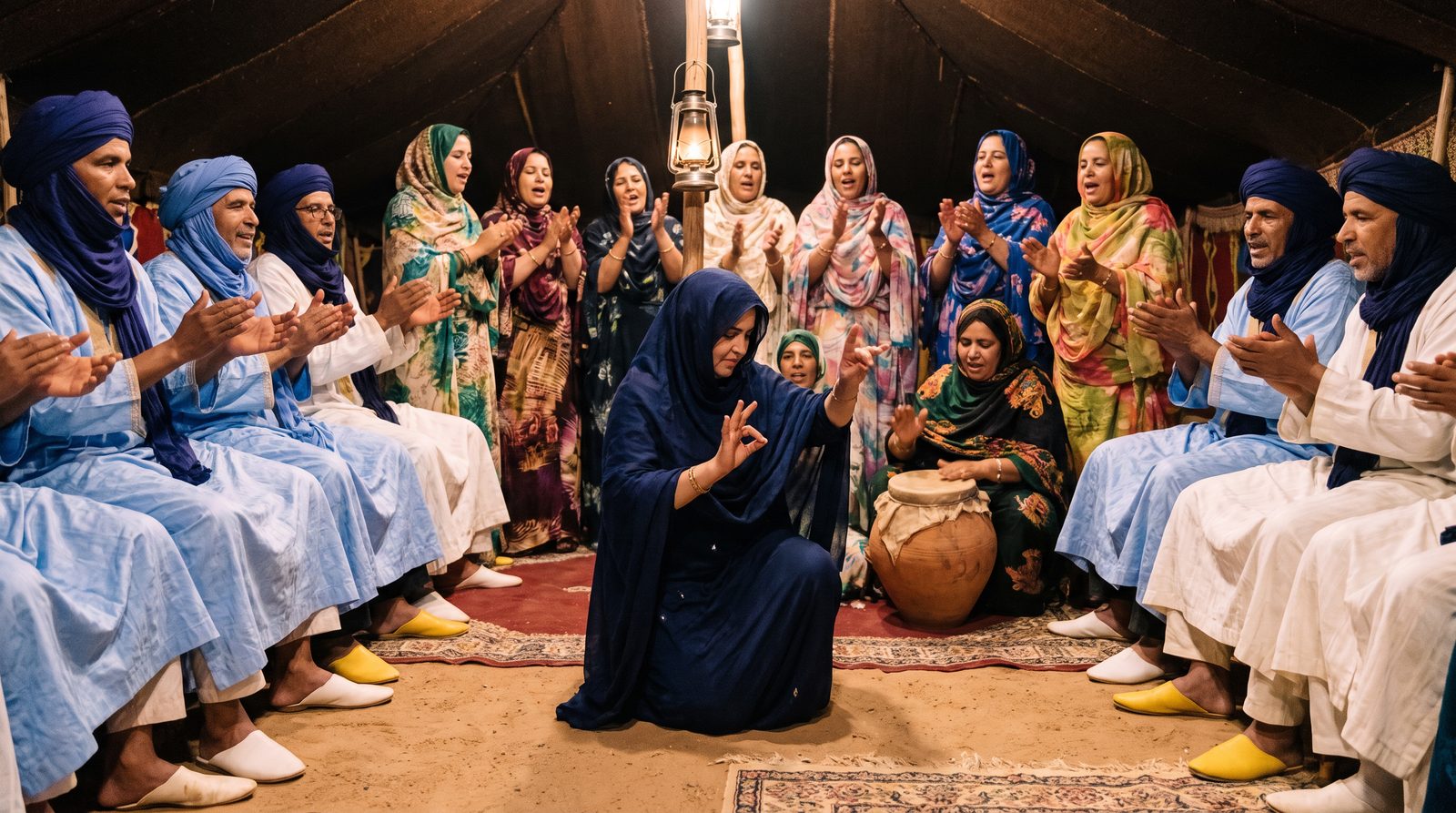
The Sahara
Hassani music and guedra, the nights of the Sahara
In the Moroccan Sahara, from Guelmim to Dakhla, the wedding often lasts several days under the khaïma. Hassani music is played on the tbal, the tidinit, a lute played by men, and the ardine, a harp played by women. The guedra, danced on the knees with the hands, comes from the Guelmim region.
The guedra takes its name from the drum that accompanies it, a cooking pot covered with skin. The women clap the rhythm around the dancer. Our guide to the Sahrawi wedding describes the days of celebration.
The instruments
- The tbal, a large drum, often played by women
- The tidinit, a stringed lute played by men
- The ardine, a harp played by women
- The guedra, a cooking pot covered with skin, which gives the dance its name
Tangier and the North
Tbel and ghaita, the processions of the North
In northern Morocco, in Tangier, Tetouan and among the Jbala, the tbel, large drums, and the ghaita, a shrill-sounding oboe, lead the groom's procession. In Tangier, the tabbala and the neffarine, who play long trumpets, are part of the ritual.
While the bride is being presented, it is often a women's band that plays, and the ceremony opens with Quran recitation and songs in praise of the Prophet. Among the Jbala, people also dance to the taqtouqa jabalia. Our guide to the Tangier wedding tells you more.
The instruments
- The tbel, a large double-headed drum, struck with two sticks
- The ghaita, a shrill-sounding oboe that opens the procession
- The nfar, the long trumpet of the neffarine, in Tangier
- The bendir and the taarija, for the women's songs and the taqtouqa jabalia
Fès, Tetouan, Meknes
Andalusian music and malhoun, the weddings of Fès
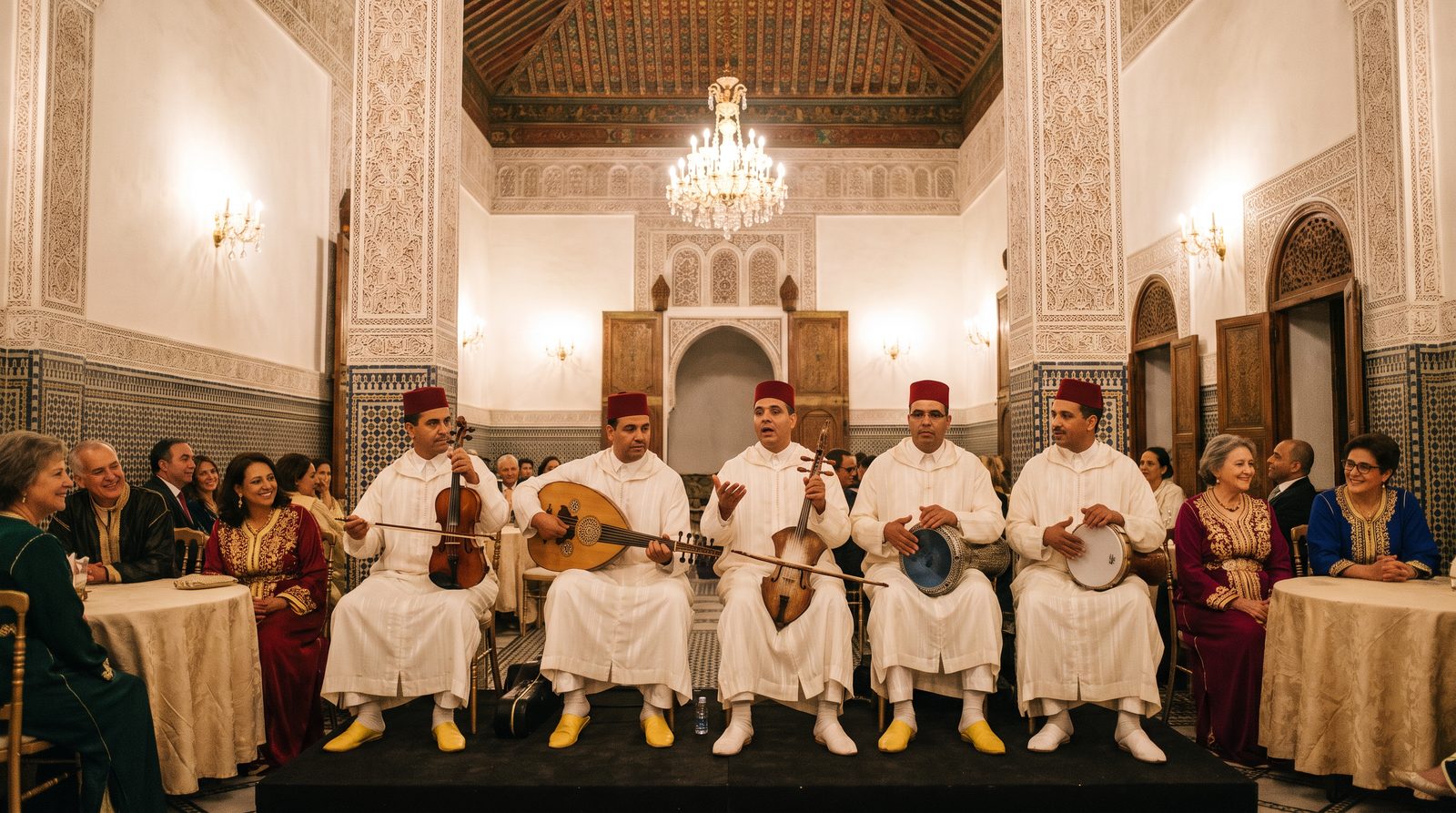
In Fès, Tetouan, Meknes and Rabat, families attached to tradition bring in an Andalusian music orchestra, the ala, inherited from Al-Andalus. Dressed in white djellabas and red tarbouches, its musicians play violin, oud, rebab and darbouka for the calmer moments of the evening.
Malhoun, poetry sung in dialectal Arabic, also keeps its place, and some families bring in an issawa or hmadcha troupe. Our guide to the Fassi wedding details how the celebration unfolds.
The instruments
- The kamanja and the viola, played resting upright on the knee
- The oud, a short-necked lute at the heart of the orchestra
- The rebab, a boat-shaped two-string fiddle
- The darbouka and the tar, the percussion, a goblet drum and a small tambourine
The budget
How much does music for a Moroccan wedding cost?
In France, a DJ for a North African wedding often costs from €800 for the evening, and a band with dakka more. In Morocco, a good band was negotiated at around 5,000 to 7,000 dirhams in 2019. Star singers invited to big weddings can cost more than 100,000 dirhams.
The price depends on the length, the number of musicians, travel and the season. Combined packages, a troupe for the entrance and a DJ for the rest, are often the best value. Always ask what is included, sound system, lighting, extra hours, and the deposit required, often around 30%.
Choosing well
How do you choose your wedding music?
To choose your wedding music, start from the two families and their regions, decide on the key moments, procession, amariya, appearances, then choose the option, DJ, band or troupe. Watch videos of recent weddings, and get everything in writing, schedule, length, repertoire and deposit.
Work out with the negafa the list of appearances and the piece for each one, and pass it on to the band or the DJ. Think of the older guests too, as an hour of chaâbi and music from their region often does more for the atmosphere than any current hit.
Questions to ask before signing. How many musicians, and for how many hours? Are the sound system and lighting included? Can you play the music of both our regions? Who handles the entrance on the amariya? How much does an extra hour cost? What deposit, and what terms if the wedding is postponed?
The outfit
What does the groom wear to dance all night?
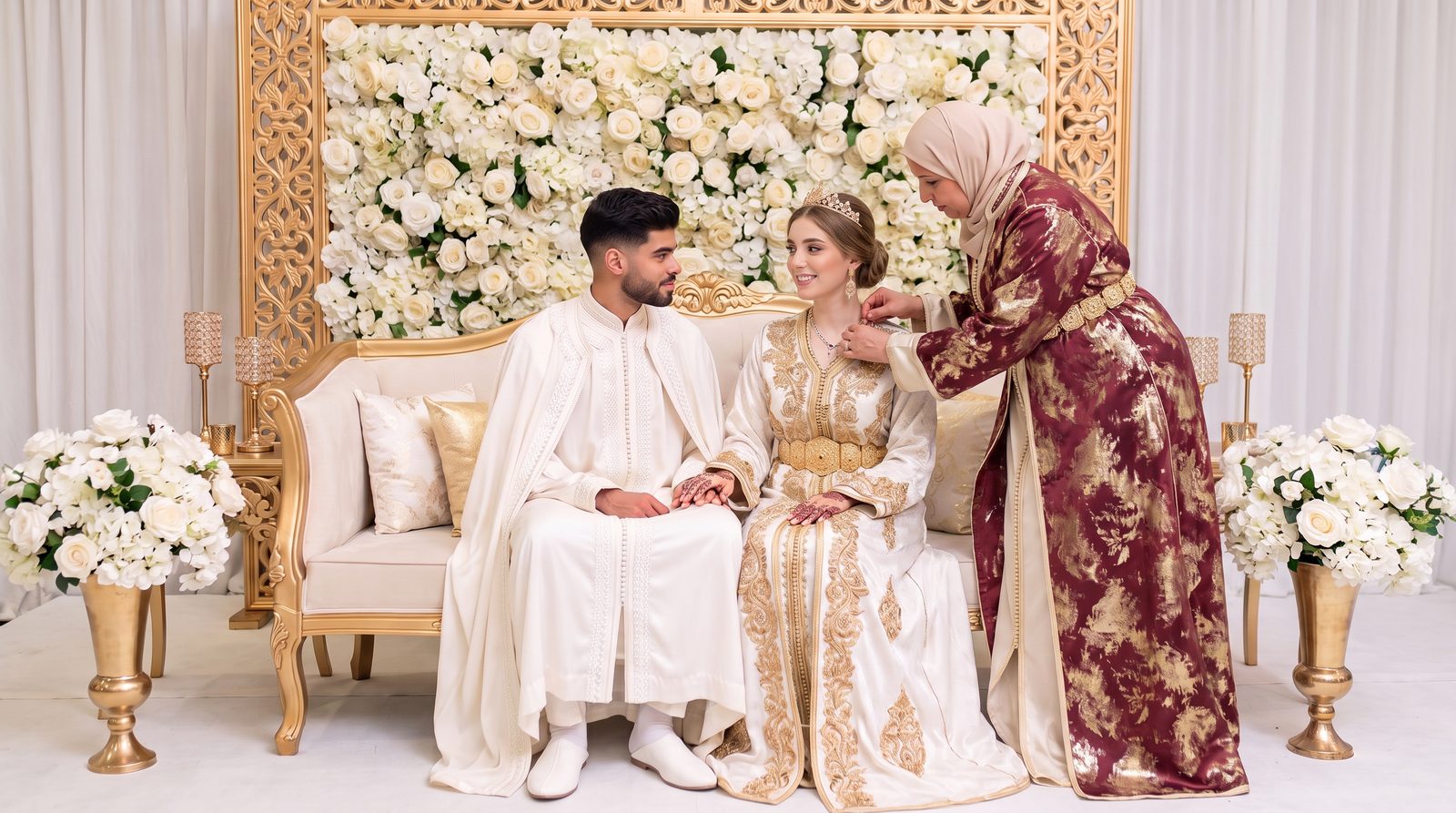
For the entrance on the amariya, the groom often wears a kaftan or a three-piece jabador, coordinated with the bride's outfit. For the dance floor, many switch to a lighter outfit, a two-piece jabador or a fine djellaba, more comfortable for moving from reggada to chaâbi.
The troupes, for their part, dance in white djellabas and red tarbouches. Jabador.com designs and makes its outfits in its workshops in Morocco, in Fès and Casablanca, and also produces for professionals, troupes, bands and reception venues. Write to us at contact@jabador.com to discuss it.
Outfits for the big night
White and gold kaftan, jabador and djellaba


Wedding guides
Planning the rest of the wedding
Music goes hand in hand with the negafa, the caterer and the henna night. Our guides detail each stage and the regional traditions, along with what the groom wears.
For the evening before the wedding, our guide to the henna night also explains the atmosphere and the music of that evening.


The right outfit at the right time
The music gets your guests dancing, and it is up to you to take care of your outfit. Every Jabador.com piece is made in our workshops in Morocco, in Fès and Casablanca.
Discover our men's jabadorsYou wonder
Frequently asked people ask
What music for the entrance on the amariya?
Most often a traditional troupe, with dakka, tbel and ghaita, or a band, with lots of percussion and youyous. Some families choose the music of their region for this moment.
DJ or band for a Moroccan wedding?
A DJ is more affordable and plays every style, while a band brings more prestige. Many couples hire a troupe for the entrance and the highlights, then a DJ for the dance floor.
What is reggada?
Reggada is a dance from the Oriental region, from Oujda, Berkane and Nador. It is danced elbow to elbow while stamping the ground, to the sound of the bendir, the zamar and the gasba. It is very present at diaspora weddings.
What is dakka marrakchia?
Dakka marrakchia is a percussion music from Marrakech. Dozens of taarija, small clay drums, play together with the qraqeb, the tara and the nfar. At a wedding, it accompanies the couple all the way to the venue.
What is aïta?
Aïta is the song of the Atlantic plains, Chaouia, Doukkala and Abda, carried by the chikhates and their musicians on violin, lotar and bendir. Its violin has remained the sound of Casablanca weddings.
How much does a DJ cost for a Moroccan wedding in France?
Often from €800 for the evening, more with a band or a dakka. The price depends on the length, the sound system and travel.
What music for a henna night?
Music that is more intimate than on the big night, women's songs, a female band or a DJ, often with regional pieces. Our guide to the henna night outfit describes the atmosphere of that evening.