
Sahrawi Wedding

The Sahrawi wedding is lived in the spirit of desert solidarity, over three days, around the melhfa and rituals all its own such as the Atarawough. We walk you through the bride's attire, the program day by day, and what the groom and guests wear.
What sets it apart
The Sahrawi wedding, a desert ceremonial
The Sahrawi wedding is a desert ceremonial, driven by tribal solidarity and an art of hospitality inherited from nomadic life. It lasts three days on average, each marked by its own rituals, songs and games around the bride and groom.
Here, the community makes the wedding. People gather under the tent, share tea and meals, and each day has its specific role. The beauty of the bride, draped in her shimmering Mlahfa, the henna, the kohl, and the gold adornments hold a central place, while the men assert their presence in their traditional Daraa.
The outfits
The Sahrawi bride's attire
The bride wears the melhfa, that long and wide veil which she wraps around herself in the manner of the haik, in often bright colors. The hands and feet are adorned with henna, the eyes lined with kohl, and the lips tinted with meswak.
The melhfa is readily accompanied by gold and adornments, and a makeup artist known as a M'aalma takes care of styling and preparing the bride. The outfit, simple in its cut yet rich in its details, reflects the understated elegance of the desert.

The jewelry
The jewelry of the Sahrawi bride
The Sahrawi bride adorns herself with jewelry that tells the story of ancient caravan routes. While modern gold finds its way there today, the soul of her adornments remains deeply rooted in solid silver and natural pearls.
At the heart of this tradition lies the essential Loubane, this precious yellow amber bead with a subtle scent, often paired with agate and colored glass beads. The neck and bust are highlighted by the Lebba, an imposing traditional necklace, while heavy silver fibulae chased with geometric motifs structure the drapes of her outfit. These powerful pieces, passed down from generation to generation, are not mere ornaments: they bear witness to the family's rank and the tribe's identity. Through this meaningful accumulation, the desert bride cultivates an authentic, understated, and proud elegance.

The atmosphere
The music of the Sahrawi wedding
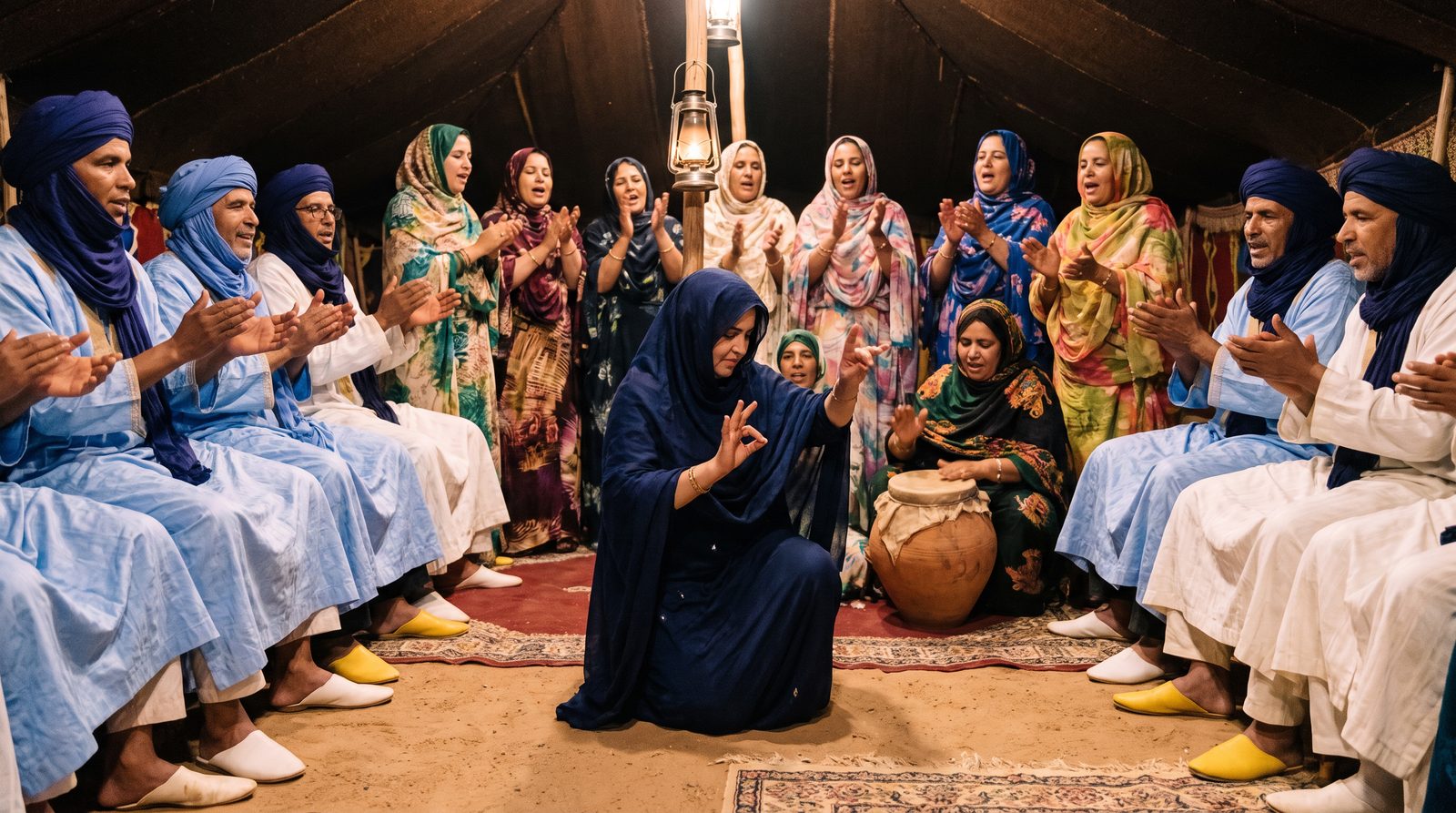
The Sahrawi wedding vibrates to the sound of the guedra, a dance accompanied by Hassaniya poetry, and Hassaniya chants carried by drums and ululations.
The haul and the azawan, the classical music of the desert, unfurl their modes all night long. The women lead the dance and the song, in a celebration where voice and rhythm matter as much as adornments. It is a festival of the spoken word and of memory.
Dinner is served
The wedding meal
In the desert, the mechoui is king. Roasted mutton or dromedary is shared among the guests, often accompanied by scented rice and bread, in boundless hospitality.
The Sahrawi table focuses above all on sharing and an abundance of meat, true to the nomadic art of hospitality. But the true master of time is tea. Served according to the famous ritual of the three glasses, its frothy preparation punctuates the evening and loosens tongues, accompanying the music until the end of the night.
The schedule
How does a Sahrawi wedding unfold?
The Sahrawi wedding spans three days. The first prepares the bride, the second is a game around the groom, and the third seals the union. Each day bears a name and a ritual of its own.
Everything happens in the tent, in the desert spirit of solidarity and sharing.
The bride's preparation
The M'aalma does the bride's hair and makeup, and applies the henna and kohl. The groom is forbidden to see her that day.
The Atarawough
The bride is hidden in a neighboring tribe, and the groom must find her, in an atmosphere of teasing that strengthens bonds.
The Ahashlaf
The young woman is given in marriage. She makes her way to the tent to the sound of the guedra and Hassani songs, amid the joy of the desert.
La Sbahiya
The next day, relatives come to see the bride in the tent and share tea and a meal, in the hospitality of the desert.
For the groom
The Sahrawi groom, the imposing Darraa
In the Sahara, masculine elegance has no use for artifice. The groom dons the Daraa, a monumental tunic designed to tame the desert climate. For his wedding, he chooses it in spotless white, cut from a rich, heavy basin cotton that gives presence to every movement.
The ingenuity of this outfit lies in its cut: the sides are entirely open to let the air circulate, revealing the seroual kanderissa, ultra-baggy pants with a very low crotch. All the subtlety of the ceremonial Darraa is hidden on the chest: the neckline and the imposing chest pocket are adorned with traditional geometric embroidery. To top it all off, the groom wraps the Hawli (the cheche) several meters long and puts on his leather sandals. At first glance, you know exactly where the groom is from. That is precisely what makes our heritage so beautiful: the incredible richness of attire so distinct and so tied to each region.

From one city to another
Weddings vary by region
The Sahara has its days of celebration under the khaïma, while the other regions have other legacies. Outfits, music and rituals change from one city to the next, and each tradition tells the story of its land.
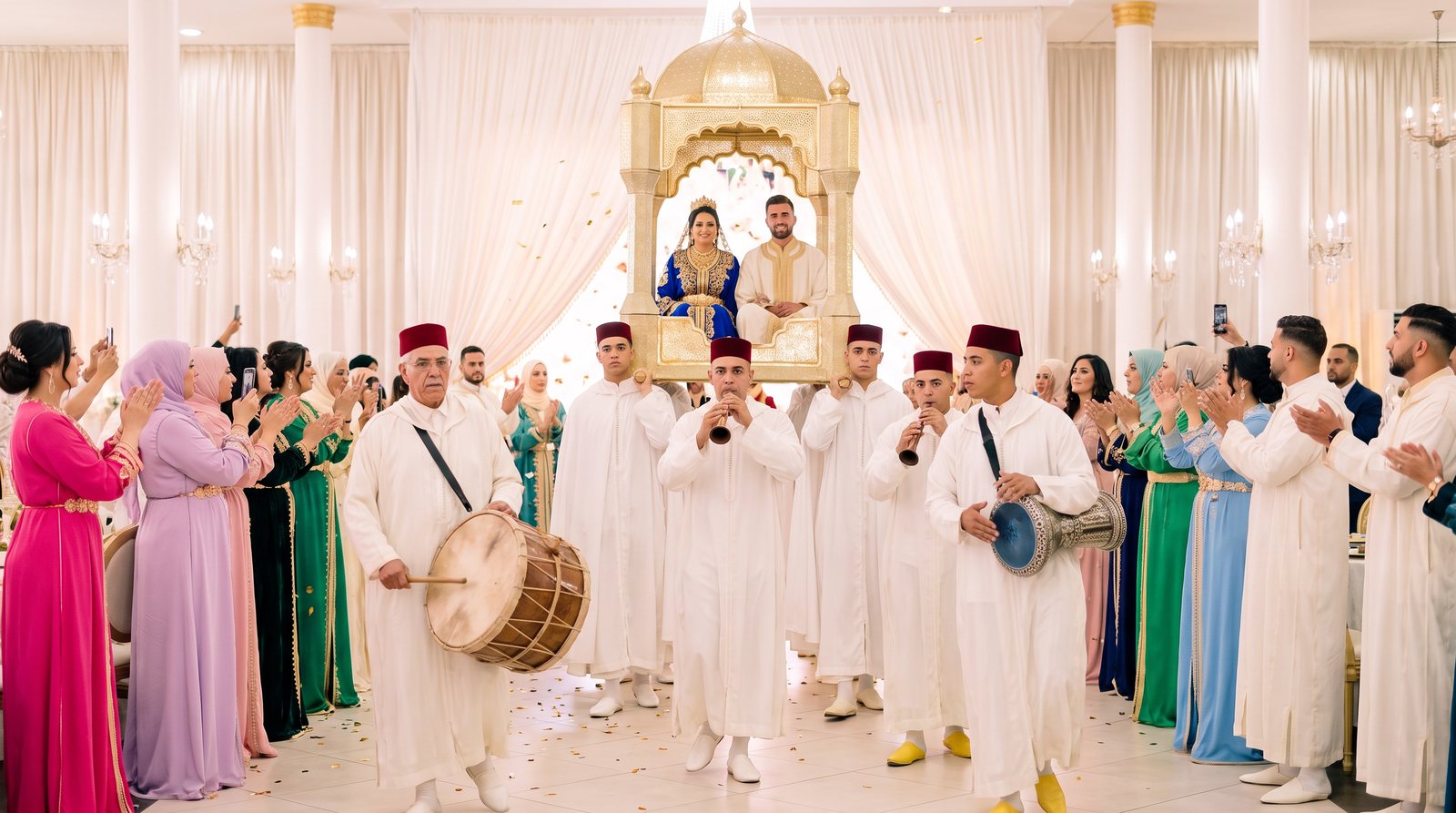
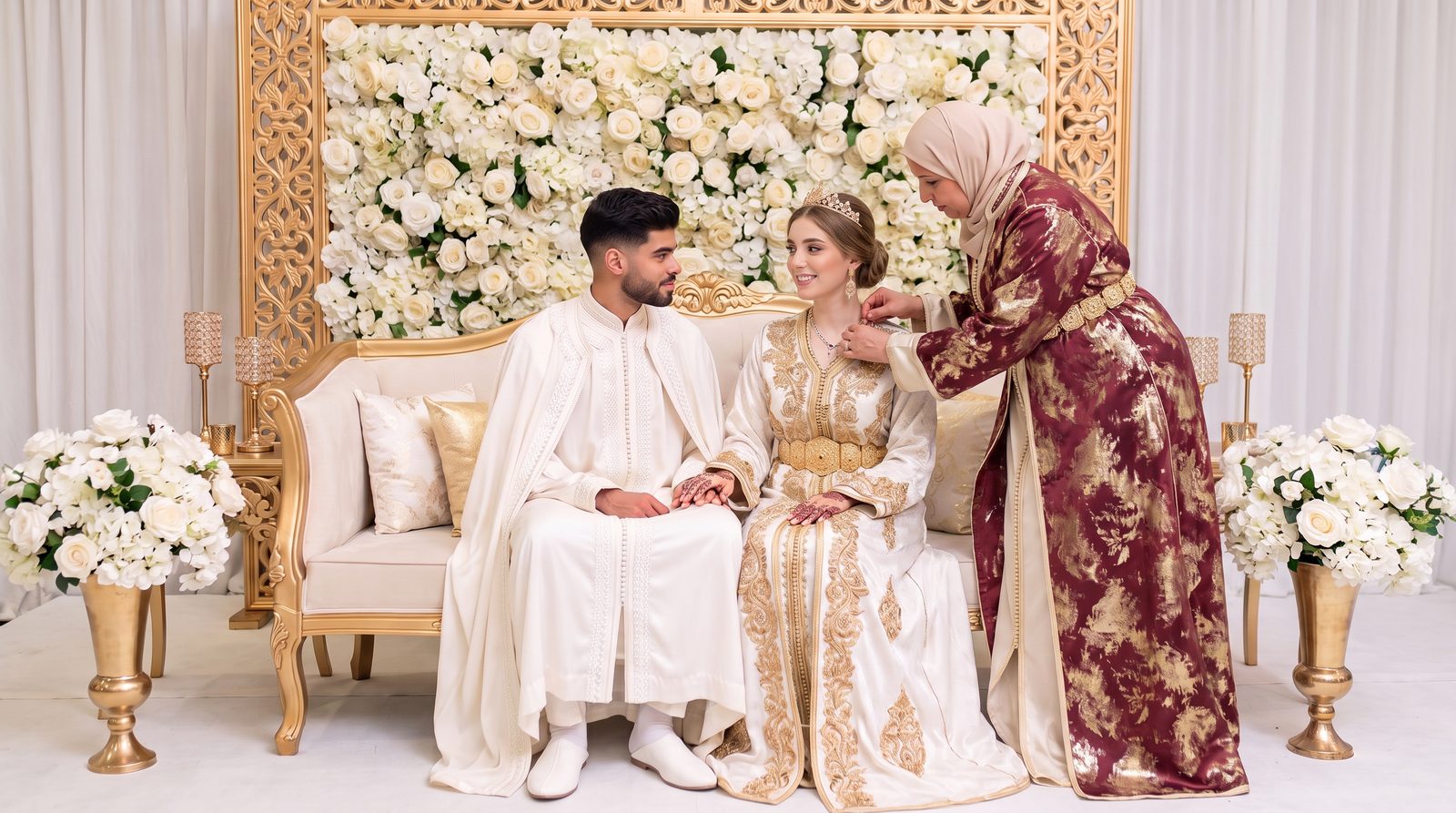
For an overview, start with our guide to the Moroccan wedding. If your family comes from elsewhere, compare with weddings in Fès, Rabat, Tangier and Oujda. The guides below take you to the Souss and Marrakech, then to the two highlights of the evening, the music and the negafa.


You wonder
Frequently Asked Questions
What is the melhfa?
The melhfa is the traditional attire of the Sahrawi woman, a long and wide veil wrapped around the body in the manner of the haik. The bride often wears it in bright colors, accompanied by gold and henna.
How long does a Sahrawi wedding last?
A Sahrawi wedding lasts an average of three days, each with its own ritual, from the preparation of the bride to the day of Ahashlaf when the union is sealed.
What is the Atarawough?
The Atarawough is a Sahrawi wedding game. On the second day, the bride is hidden in a neighboring tribe and the groom must find her, in a playful atmosphere that strengthens the bonds between families.
What jewelry does the Sahrawi bride wear?
The Sahrawi bride adorns herself with amber and chased silver jewelry, sometimes gold for the Lebba, adornments that tell the story of ancient caravan routes.
What music do people listen to at a Sahrawi wedding?
The Sahrawi wedding vibrates to the sound of the guedra, a dance accompanied by Hassani poetry and Hassani songs. The haul and the azawan, the classical music of the desert, set the rhythm for the night.
What do people eat at a Sahrawi wedding?
The méchoui is central, roasted sheep or dromedary, accompanied by rice and bread. Tea, served several times, punctuates the evening as much as the music.
What does the groom wear at a Sahrawi wedding?
The groom often wears a darraa, a loose-fitting desert tunic that comes in blue or white. For a Moroccan formal outfit, a white djellaba or a light-colored jabador are appropriate. See the jabador man.
What do guests wear to a Sahrawi wedding?
Guests wear simple, heat-appropriate attire—djellaba or a lightweight jabador for men. White is generally reserved for the bride and groom.