
Fassi Wedding

The Fassi wedding is the most prestigious in Morocco. Everything revolves around the chedda fassia, the ceremonial finery inherited from the great families of the medina, its gold jewelry, and Andalusian music. We walk you through the outfits, jewelry, music, and how a wedding unfolds in Fez.
What sets it apart
The Fassi wedding, Morocco's most prestigious
The Fassi wedding stands out for its Andalusian refinement and the chedda fassia, considered the noblest bridal attire in the kingdom. Fez, the spiritual capital, has kept a meticulous ceremony in which every detail, whether embroidery, jewelry, or henna, follows a code.
Founded in the ninth century, Fez has blended Arab, Andalusian, Amazigh, and Jewish influences that are reflected in its craftsmanship. The region's wedding costumes and jewelry carry a distinct hallmark recognized throughout Morocco, synonymous with nobility and wealth. This reputation is not a matter of chance; it is based on centuries of expertise passed down in the workshops of the medina.

The outfits
The Fassi bride's attire
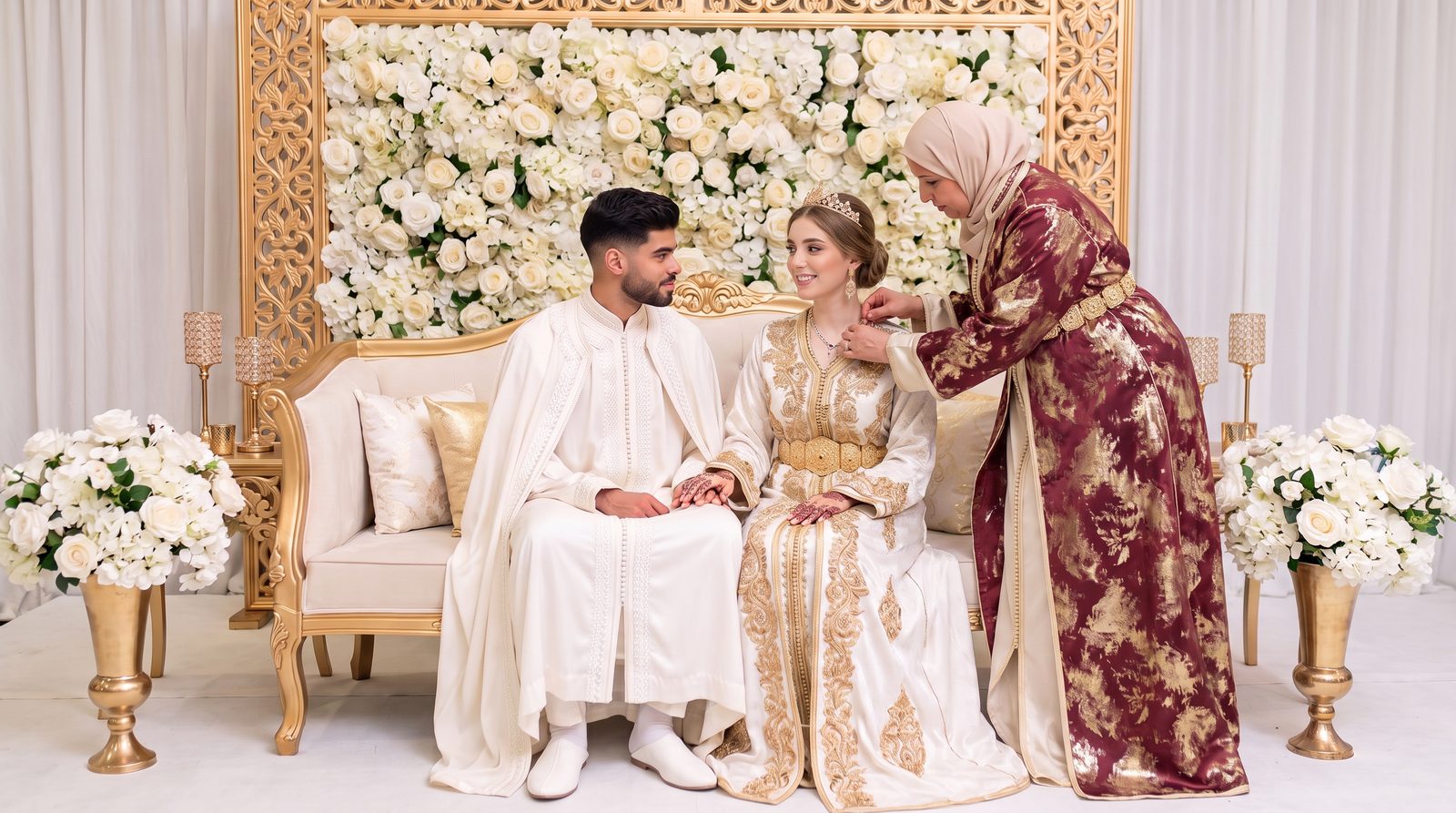
The centerpiece is the chedda fassia, also called lebsa del joher, “the pearl outfit,” a ceremonial ensemble heavy with embroidery and jewelry, cinched at the waist by the mdamma and crowned with a taj. As the evening goes on, the bride appears in several kaftans.
What defines the Fassi outfit is tarz fessi, an embroidery of geometric patterns worked in gold or silver thread, an art passed down from generation to generation. The kaftan is cut from precious brocades such as deniyajat, often white or gold. The takchitas and kaftans that people buy are mostly worn by the guests, sisters, and mothers, while the bride wears the negafa's outfits. For an elegant starting point, a Moroccan takchita or a finely made women's kaftan captures the look.


The jewelry
The jewelry of the Fassi bride
The Fassi jewelry set is the queen of gold and pearls. On the head, the taj, the tiara, rests on a cushion that adds volume to the hairstyle. The forehead is adorned with the selta, a pearl jewel with a green stone, framed by the zraier, those clusters of pearls that fall on each side.
On the chest sits the lebba, a necklace with five pendants, along with several strands of pearls, the mdayej, separated by green beads. The nouasi, long bands of black satin embroidered with pearls, complete the headdress, and the waist is cinched with the mdamma, the ceremonial belt. Gold and pearls alike are passed down and rented out from generation to generation, a refinement that has made Fez jewelry famous throughout the kingdom.
The atmosphere
The music of the Fassi wedding
In Fez, weddings unfold to the sound of tarab al-ala, the Arab-Andalusian music inherited from al-Andalus. A string orchestra plays the noubas, the long musical suites that set the rhythm for the bride's appearances.
This classical music, passed down for centuries, is the pride of the city, carried by ensembles such as the El Hadj Abdelkrim Rais orchestra. Malhoun, Morocco's sung poetry, also has its place, as do the Sufi chants of the brotherhoods at certain evening gatherings. Nothing flashy: the Fassi atmosphere cultivates elegance in sound as much as in dress.

Dinner is served
The wedding meal
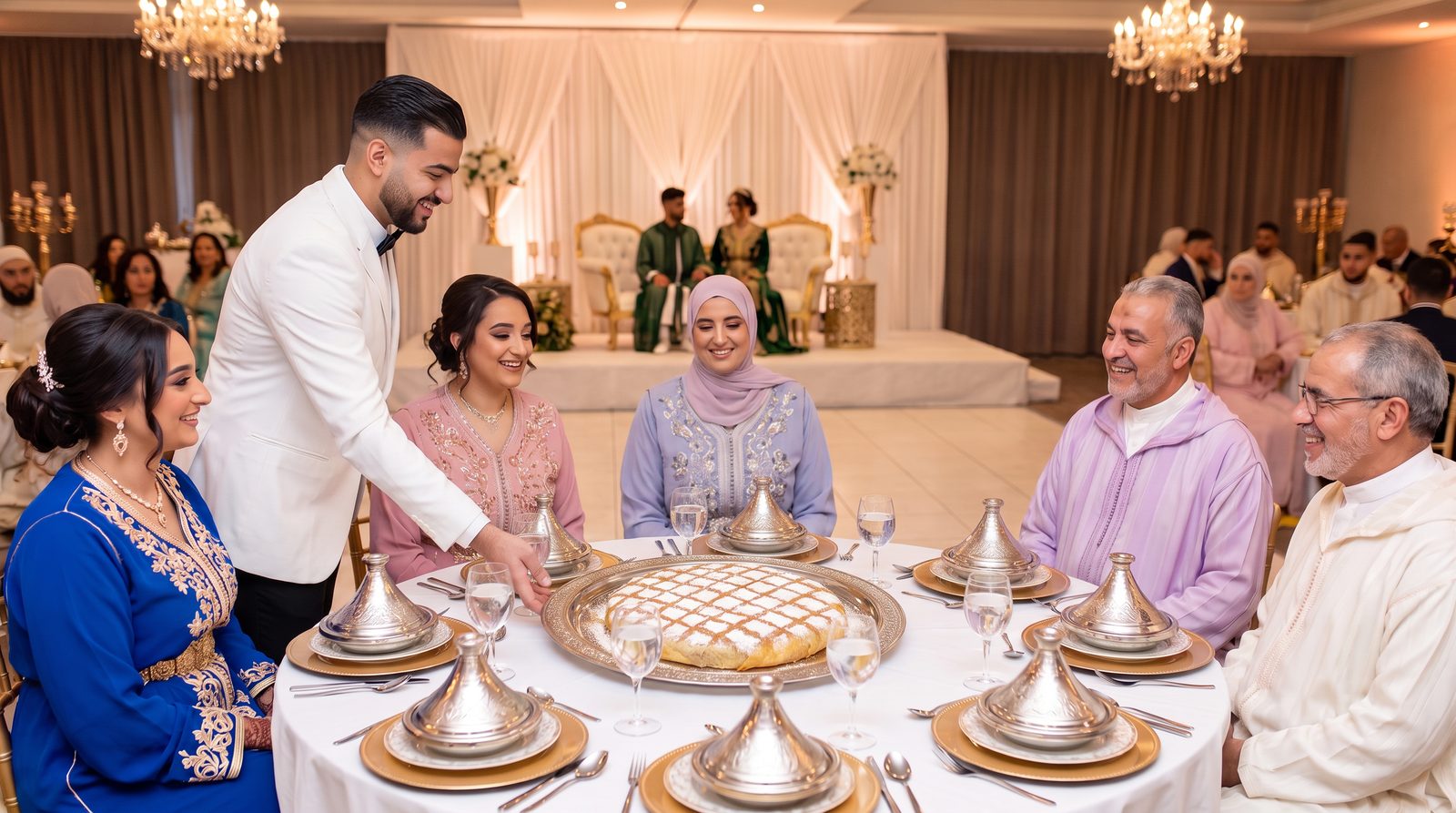
The Fassi dinner is served in several courses, in the purest tradition of the city. It almost always opens with pastilla, of which Fez is the birthplace, before the main course and a sweet finale.
Sweet, savory, and crispy, pigeon bastilla is the Fassi signature dish. Next comes the méchoui or a refined tagine, followed by pastries, fruit, and mint tea. Nothing is left to chance: the Fassi table is meant to be as polished as the outfits.

The schedule
How does a wedding unfold in Fez?
Fez weddings follow the major Moroccan steps, but with a refinement specific to the city. From the khotba to the grand evening, every moment is carefully crafted.
The entrance of the bride on the amariya takes place to the sound of Andalusian music, in a subdued atmosphere where elegance reigns from the very first kaftan to the last adornment of the night.
The khotba and the dowry
The two families agree on the dowry, the date, and the organization. The payment of the dowry, recorded in the contract before the adoul, marks the end of the engagement.
The ritual bath
Two weeks before, the bride goes to the hammam for ritual ablutions. The Takbib ceremony, washing with seven buckets of water, purifies her before she moves into her new home.
Fassi henna
The nekacha applies henna with meticulous geometric patterns to the bride's hands and feet, a hallmark of Fez.
The big evening
The negafa adorns the bride with the chedda and its gold jewelry before she takes her place on the amariya, to the sound of Moroccan and Andalusian music. The bride wears several kaftans over the course of the night.
La Sbahiya
The next day, the bride's family brings a festive meal of harira, chebakia, and dates, and relatives come to visit her in her new home. It is also the time of the hdiya, the husband's gifts.
For the groom
The Fassi groom, Moroccan refinement
In Fez, the groom pays close attention to every detail. He usually wears a white-and-gold three-piece jabador, or a white djellaba and a tarbouche, over a randa shirt paired with kandrissi harem pants.
The embroidery is fine and the cut clean, in the off-white and white-and-gold tones that define Fassi splendor. For guests, the jabador and the djellaba work for any occasion, in understated shades.
A documented heritage
The Fassi Wedding as Seen by Roger Le Tourneau
The Fassi wedding ceremony is one of the best documented in Morocco. As early as 1947, the historian Roger Le Tourneau described its course, from the engagement to the seven wedding nights, a sequence of meticulously prepared ceremonies specific to the families of the medina.
In Fez, a wedding once stretched over seven days and seven nights. The payment of the dowry, recorded in the contract before two notaries, marked the end of the engagement. Then came the preparation rites, including the Takbib, the ritual bath of seven ablutions that purified the bride before she moved into her new home. The negafa welcomed her at the threshold of the bridal chamber with a bowl of milk and dates, gestures of welcome and good fortune that are still alive today.
From one city to another
Weddings vary by region
Fez has its own codes, but every region in Morocco celebrates weddings in its own way. Outfits, jewelry, and rituals change from one city to another, and that is what makes each celebration unique.
For an overview, start with our guide to the Moroccan wedding. If your family comes from elsewhere, compare with weddings in Oujda, Marrakech, the Souss and the Sahara. The guides below take you to Rabat and Tangier, then to two pillars of the celebration, the negafa and the caterer.


You wonder
Frequently asked people ask
Why is the Fassi wedding considered the most prestigious?
Fez has long been the intellectual and artisanal capital of Morocco. Its wedding attire and jewelry, notably the chedda fassia, have kept a level of refinement recognized throughout the kingdom.
What is the chedda fassia?
The chedda fassia is the traditional bridal finery of Fez, heavy with gold-thread embroidery and jewelry. It is one of the noblest bridal outfits in Morocco, worn for the entrance on the amariya.
What is tarz fessi?
Tarz fessi is the traditional embroidery of Fez, featuring fine geometric patterns made with gold or silver thread. It can be found on the chedda and on many ceremonial kaftans.
What jewelry does the Fassi bride wear?
The Fassi jewelry set combines gold and pearls, with the taj on the head, the selta on the forehead, the lebba on the chest, and the mdayej and mdamma at the waist. These jewels are passed down from generation to generation.
What music do people listen to at a Fassi wedding?
The Fassi wedding unfolds to the sound of tarab al-ala, the Arab-Andalusian music of Fez, played by a string orchestra performing the noubas. Malhoun and Sufi chants sometimes join in.
What do people eat at a Fassi wedding?
Dinner begins with pastilla, of which Fez is the birthplace, often filled with pigeon, before the méchoui or a refined tagine, followed by pastries, fruit, and mint tea.
What does the groom wear at a Fassi wedding?
The embroidered jabador remains the groom's signature outfit. Many plan for two: one for the official entrance and a lighter one for the party. You'll find beautiful options among our jabador man.
What do guests wear to a wedding in Fez?
The guests blend polished traditional attire with fine evening wear, in the understated elegance characteristic of Fez. White and gold remain the exclusive domain of the bride and groom.