
The jabador is a traditional Moroccan outfit consisting of a tunic, pants, and sometimes a cape. First mentioned in the 16th century among the nobility of Fez, it owes its unique character to the craftsmanship of Moroccan artisans, featuring hand-woven sfifa and aakad patterns and gold-thread embroidery.
From the Dynasties to the Notables of Fez
The Moroccan jabador through the centuries
The jabador has its roots in Moroccan court attire. From the Marinid workshops of Fez to the splendor of the Saadians, passing through its first written mention by Leo Africanus in 1525, it has traversed dynasties without ever losing its urban and refined soul.
Written records of the jabador can be found long before it bore that name. In its Description of Africa Published around 1525, Hassan al-Wazzan, known to Europe as Leo Africanus, already describes the long, open garment worn by the notables of Fes. At that time, the attire was reserved for merchants, ambassadors, and wealthy urban families. It was made of brocade and velvet.
Before Islam · the drape
A long wrapped fabric
From the Middle Atlas to the Sahara, traditional costume is based on draping, an Amazigh heritage from the depths of ages. A long piece of fabric, the izar, is wrapped around the waist and then brought over the shoulders and fastened with fibulae. It is the distant matrix of Moroccan clothing, before cutting and sewing.
Marinid dynasty · 1248 – 1465
The birth of a court garment
Under the Marinids, clothing established its codes. This is the period when the visual foundations of traditional Moroccan prestige attire were laid in the workshops of Fez, which became the heart of the kingdom's craftsmanship.
1525 · first mention
Leo Africanus describes the nobles of Fez
Visit Description of Africa recorded in writing what Moroccans were already wearing. The attire is that of the urban elite, crafted by the best artisans, in the richest fabrics.
Saadians · 1511 – 1670
The pinnacle of refinement
The Saadians bring court attire to its peak. Brocade, velvet, and gold and silver thread embroidery, the garment becomes as much an object of art as a marker of power, worn during major palace ceremonies.
Alawites · 17th century to the present
The opening and dissemination
Under the Alaouites, Morocco opens up to Europe. Diplomats and ambassadors travel, European painters depict Moroccan attire, and the clothing once reserved for notables gradually spreads throughout society.
What this long story tells is a continuity. The jabador was not invented on a specific day. It is the result of several centuries of Moroccan refinement, passed down from workshop to workshop, until it became the outfit we know today.
A reference source
The Moroccan costume as seen by Jean Besancenot
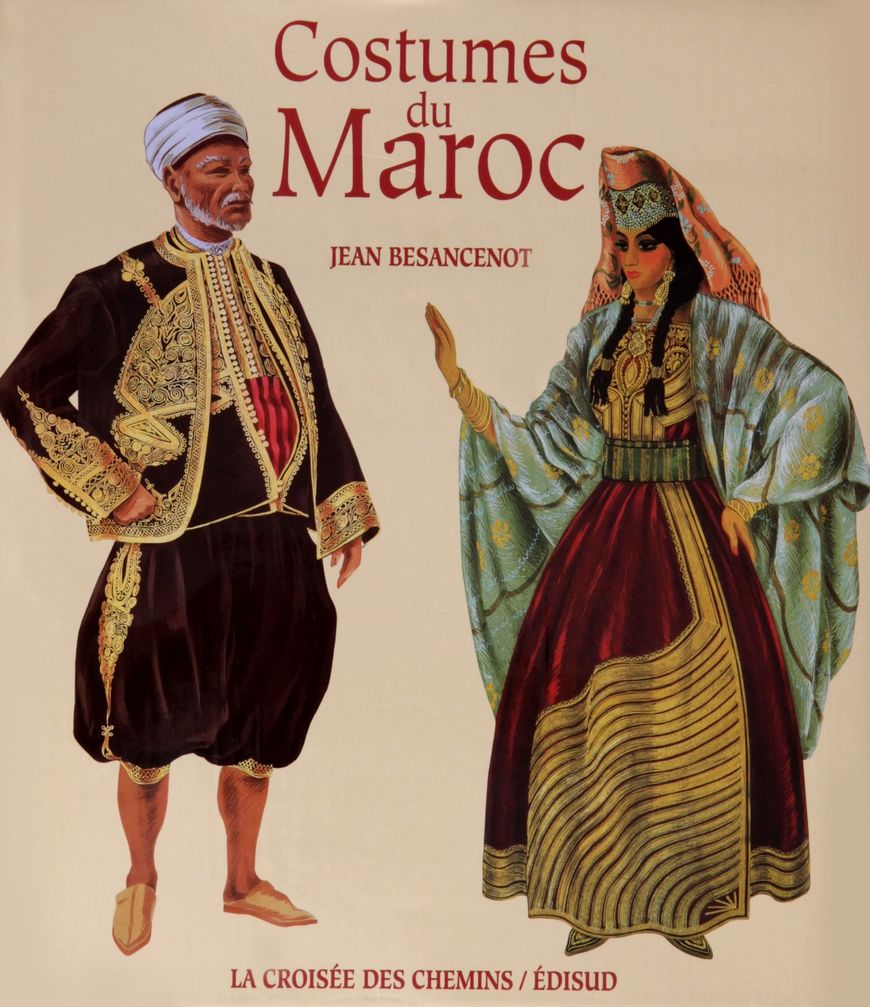
In the 1930s, the French artist Jean Besancenot traveled across Morocco to draw its traditional costumes. His work Costumes du Maroc remains a reference for understanding the richness of Moroccan attire, region by region.
His records show how the jabador changes from one region to another, with the urban garment differing from that of the countryside. They also recall a constant of Moroccan men's costume, the sobriety of outdoor attire, such as the jabador or the djellaba, and the richness of the loungewear, such as kaftan or the gandoura. As many nuances that Moroccan artisans perpetuate today.
The two- or three-piece outfit
What is a jabador?
A jabador is a traditional Moroccan outfit consisting of a tunic, trousers, and sometimes a cape. Coordinated in the same tones and finishes, these pieces form a refined ensemble worn for special occasions.
The jabador consists of three coordinated pieces. A tunic straight-cut, with a front closure accented by sfifa, braided trim, and aakad buttons running the entire length. A pants, straight cut or the kandrissi type, which is shorter and roomier in the crotch. And, for the dressiest outfits, a cape, also called an abaya, worn over the shoulders. It is this set designed to go together, in the same tones and with the same finishes, that distinguishes the jabador from a simple tunic.
Today, the sfifa is almost always adorned with embroidery—both along the tunic and at the bottom of the pants—in a matching shade across the tunic, pants, and cape. These patterns have their own names—there are hundreds of them—including classics that Moroccans recognize at a glance.
It can be worn for a wedding, for Eid, or for Friday prayers. Depending on the style, it comes in two- or three-piece sets, ranging from simple to richly embroidered. Discover all our styles in the category jabador man.
Origins of the name
Where does the word jabador come from?
The word jabador has no official etymology, and sources contradict each other. The most coherent hypothesis, in Darija, links its name to the root jbed, to pull or adjust.
Whereas the djellaba is a loose, draped garment, the jabador is a structured ensemble—a tunic and matching pants—tailored to follow the silhouette without ever constricting it. The name would therefore suggest something simple—a garment that holds its shape, as opposed to fabric that flows.
A universal principle, a single outfit
The jabador, a Moroccan signature
Pairing a tunic with trousers is not a Moroccan invention; it can be found in India, Pakistan, West Africa, and even among Native Americans. What is uniquely Moroccan is the jabador, the way our artisans have transformed this ordinary ensemble into an exceptional outfit.
The tunic and trousers principle of dress is found on almost every continent. In India and Pakistan, the kurta-pyjama and the salwar kameez pair a long tunic with loose trousers. In West Africa, the boubou and the agbada outfit men in fluid, embroidered fabrics. Even Native Americans wore a tunic over leather leggings. The principle is universal because it is simple, comfortable, and suited to hot climates.
But everywhere else, this set remained a tunic and trousers. In Morocco, our artisans made something else out of it. They gave it a cut, finishes, and a name: the jabador.
That is the whole difference. The word jabador does not refer to just any tunic paired with just any trousers. It refers to our The Moroccan version, with its specific design elements: kandrissi pants, sfifa braiding, aakad hand-braided buttons, and gold-thread embroidery. A tunic and pants—you can find those anywhere. A jabador, however, can only be found in Morocco.
The artisans' craft
Moroccan craftsmanship, what makes the jabador unique
What sets a jabador apart from an ordinary tunic is the craftsmanship of Moroccan artisans: the sfifa trim that highlights the contours, the hand-braided aakad buttons, the gold-thread embroidery, and the kandrissi pants, which are embroidered all the way down to the pockets.
Take an ordinary tunic and pair of trousers. Entrust them to a Moroccan maâlem, a master artisan. What emerges is no longer ordinary. Every detail is the result of a gesture passed down from generation to generation, from the workshops of Fez and Salé.
Trimming
The sfifa
This braided trim accentuates the edges, neckline, and closure of the tunic. Long applied by hand, it is now most often machine-sewn. Its patterns go by several names, and the quality of the thread quickly drives up the price per meter. Be wary of vinyl sfifas—we strongly advise against them.
The buttons
The aakad
These small braided-thread buttons fasten the tunic one by one. Each aakad is tied by hand—sometimes by the dozen on a single garment. It’s a labor of patience that a machine simply cannot replicate.
The patterns
The embroideries
Along the sfifa and down to the bottom of the pants, the embroidery forms patterns with names of their own, such as Gouza or Debanna. On ceremonial garments, the fetla—embroidered with gold or silver thread—adds a touch of elegance, a legacy of Saadian court attire. Long made by hand, they are increasingly being produced by machine to reduce costs.
The pants
Kandrissi and its finishes
The pants can be straight-cut or kandrissi-style—shorter but wide and very baggy in the crotch. Moroccan artisans have added sfifas to highlight the pockets and finish the hem, with aakad buttons. A detail much appreciated by Moroccans, the sfifa on the pants sometimes forms the shape of a khandjar—the dagger that artisans replicate along the seam. A genuine jabador is also judged by its pants.
From everyday life to the ceremony
The fabrics of the jabador
The fabric gives the jabador its entire character, and it changes depending on the piece. For the tunic and trousers, mlifa or gabardine are most commonly used, with the latter having taken over in recent years due to its value for money.
The cape, or abaya, serves a different purpose. It can be chosen in a sheer style, made of muslin or sousdi—which is more luxurious and expensive—or in velvet for a more formal look. Among the younger generations, some prefer to wear the tunic on its own—often shorter in length—made of velvet or brocade, paired with matching sfifa and aakad accessories.
The moments that matter
When to wear the jabador?
The jabador is worn for major Moroccan occasions, such as weddings—where the groom wears it as his ceremonial attire—as well as the Eid, the henna night, and Friday prayers. It is the garment of celebrations and traditions.
The jabador is not an everyday garment for most Moroccans. It is the attire for moments that matter, the one brought out to honor a celebration or a tradition.
Marriage
This is the ultimate occasion. The groom often wears several outfits, including an embroidered jabador for the ceremony. All about the Moroccan wedding and its traditions.
Eid
For the'Eid al-Fitr Just as with the Eid el-Kebir, people put on their finest clothes. The jabador—whether plain or colorful—is worn during prayer and family visits.
The henna party
Before the wedding, the henna night brings family and friends together. The jabador naturally finds its place there, often in light or pastel tones.
The Friday prayer
For the jummah, many men choose a traditional outfit. The jabador, loose and dignified, respects the setting while remaining elegant.
An outfit for the whole family
The jabador for men, women, and children
The jabador can be worn at any age. The men's cut remains the most emblematic, but it also exists in a refined women's version and as children's wear, with the same artisanal finishes in their size.
Long worn by both men and women, the jabador has been adapted for the whole family. Today, everyone can find their outfit, from the father to the youngest child.
The men's jabador
The traditional cut, from the understated model to the richly embroidered wedding outfit. Our complete men's collection.
The women's jabador
An elegant, delicately embroidered women's version for holidays and ceremonies. Discover the women's jabador.
For children
The same finishes in their size. Our Moroccan outfits for boys accompany children on special occasions.
Key takeaways
A tunic, trousers, and a whole lot of know-how
The jabador tells a simple and proud story. It is the story of a garment found all over the world, which Moroccan artisans have, over the centuries, transformed into an outfit that is instantly recognizable. The sfifa, the aakad, the gold thread, the kandrissi pants—it is these details, and the hands that craft them, that define the Moroccan essence of the jabador.
Wearing it is continuing this story. Discover our models in the category jabador man, and for special occasions, also discover our djellabas, caftans and gandouras.
FAQ
Frequently Asked Questions
What is the difference between a jabador and a djellaba?
The djellaba is a one-piece garment, a long hooded dress worn over other clothes. The jabador, on the other hand, is a two- or three-piece ensemble consisting of a tunic, pants, and sometimes a cape. The jabador is more formal, while the djellaba is more casual.
Is the jabador only for men?
No. Originally, it was a unisex outfit, worn by both women and men. Today, the men's cut is the most widespread, but there are jabadors for women and children, featuring the same artisanal finishes.
Why is the jabador said to be Moroccan when the tunic exists elsewhere?
Because the word “jabador” does not refer to just any tunic and pants, but specifically to the Moroccan version of this ensemble, with its distinctive cut, kandrissi pants, sfifa braiding, aakad buttons, and gold-thread embroidery. The concept is universal, but the jabador is Moroccan.
When to wear a jabador?
The jabador is worn for special occasions, such as weddings, Eid al-Fitr and Eid al-Adha, henna nights, and Friday prayers. Depending on the fabric and embroidery, it can be suited to anything from a simple celebration to a grand ceremony.
What is kandrissi pants?
The kandrissi is the traditional trousers that accompany the jabador. Both loose and structured, it often features its own embroidery, with sfifas along the pockets and the cut. It is a marker of quality; a true jabador is also recognized by its trousers.
Where does the word jabador come from?
It has no official etymology. The most plausible explanation, in Darija, links its name to the root *jbed*, meaning “to pull” or “to adjust.” Whereas the djellaba is loose and draped, the jabador is a structured ensemble—one that holds its shape rather than flowing freely.
One Reply to “Histoire du Jabador Marocain”
Arabian Morocco
The jabador, the Haik, and the Kaftan are of Arab origin and used by the Arabs of Morocco, correct this information